
Machine Learning Operations for BFSI: How Redian Software Builds Production-Grade Machine Learning Pipelines
A reference architecture for production MLOps in banking — real-time drift detection, SR 26-2 / NIST model governance, Explainable AI, and a fraud detection pipeline at 99.2% accuracy with sub-10ms inference latency.

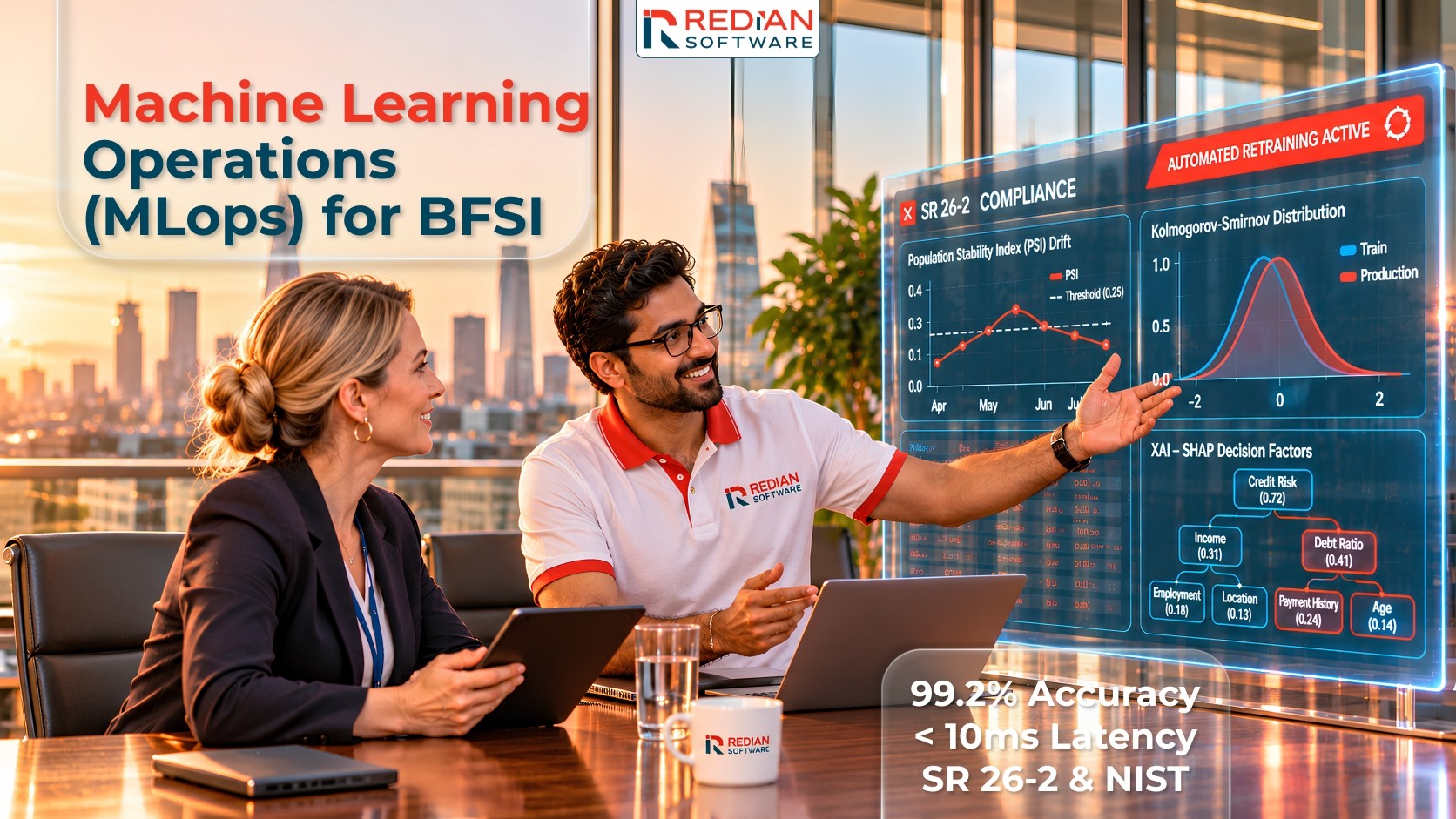
Reference Architecture, Drift Detection, Model Governance, and Fraud Detection at 99.2% Accuracy
Why Do Most Financial Machine Learning Models Fail in Production?
Financial institutions invest heavily in artificial intelligence, yet over 85% of machine learning models never reach live production. Models that do deploy often decay silently, exposing lenders to underwriting blind spots, compliance penalties, and rising fraud losses.
The problem is rarely the mathematics. Rather, it is the lack of specialized MLOps for BFSI built for the transaction velocity, strict regulations, and shifting data distributions typical of banking. When teams train models on static historical data in offline notebooks, assumptions break once live traffic begins.
In production banking environments, four structural vulnerabilities routinely derail unmanaged models:
- Training-Serving Feature Skew: Features computed in offline batch systems differ in logic and temporal precision from features generated in real time by payment switches, causing erroneous production inferences.
- Silent Concept and Data Drift: Economic shifts, seasonal merchant surges, and new fraud techniques alter financial behaviors rapidly. Without automated statistical telemetry, models decay unnoticed while continuing to issue confident predictions.
- Core Banking Integration Bottlenecks: Prototypes rarely integrate cleanly with high-throughput banking mainframes or message buses, causing API latencies to exceed the sub-100ms thresholds required by payment networks.
- Regulatory Obscurity: Regulators require clear model lineage and explainability. Black-box models that cannot explain why a credit application was denied or a payment flagged face immediate operational shutdowns.
To resolve these challenges, institutions partner with experienced engineering firms to implement production grade machine learning pipelines. Through our dedicated enterprise AI and ML consulting services and comprehensive BFSI software solutions, Redian Software converts fragile laboratory scripts into resilient production workflows.
What Is the Enterprise BFSI MLOps Reference Architecture?
A robust financial services MLOps reference architecture unifies streaming ingestion, low-latency feature stores, automated training, and zero-downtime serving across six decoupled tiers in hybrid environments.
Our engineering practice follows the Google Cloud MLOps continuous delivery and automation framework and the AWS Well-Architected Machine Learning Lens. We also apply NVIDIA MLOps enterprise acceleration guidelines to ensure distributed training and real-time tensor computation scale smoothly. When executing infrastructure modernizations, our multi-cloud DevOps and infrastructure engineering specialists configure Kubernetes clusters featuring automated horizontal scaling and multi-region failover.
How Does Real-Time Drift Detection Prevent Silent Model Decay in Banking?
In production banking environments, predictive models rarely crash with clear runtime exceptions. Instead, they fail silently through statistical drift. A credit scoring algorithm or fraud detection service continues returning successful HTTP 200 responses with low latency while making increasingly flawed decisions. Redian Software deploys rigorous machine learning drift detection banking frameworks that decouple input shifts from relationship decay, establishing automated triggers before losses accumulate.
Differentiating Covariate Shift from Concept Drift
Maintaining production accuracy requires continuous concept drift and covariate shift monitoring:
- Covariate Shift (Input Feature Drift): Occurs when the distribution of input features P(X) shifts over time while the underlying conditional probability distribution P(Y|X) remains unchanged. For example, when a bank expands digital lending to new demographics, applicant income profiles change, shifting input distributions without altering core credit dynamics.
- Concept Drift (Relationship Shift): Occurs when the relationship between input features and target outcomes P(Y|X) changes, even if input distributions appear stable. In fraud detection, concept drift takes place when criminal networks alter transaction techniques, rendering previously safe merchant payment behavior suddenly fraudulent.
Statistical Monitoring Techniques & Automated Retraining Triggers
Rather than relying on arbitrary monthly retraining calendars, Redian Software integrates continuous statistical monitoring via Evidently AI open-source drift evaluation harnesses, calculating key statistical metrics across sliding transaction windows:
- Population Stability Index (PSI): Calculated continuously on numerical feature bins. Values below 0.10 confirm stability; values between 0.10 and 0.25 initiate engineering warnings; values above 0.25 represent substantial drift and trigger shadow retraining routines.
- Two-Sample Kolmogorov-Smirnov (KS) Test: Evaluates continuous feature distributions against baseline reference sets, detecting subtle distributional shifts in transaction values and temporal velocity at p < 0.01.
- Wasserstein Distance: Calculates the effort required to transform live feature distributions into baseline distributions, providing interpretable drift magnitude scores across skewed banking metrics.
- Automated Continuous Training (CT) Orchestration: When statistical boundaries are breached, our pipelines launch an automated retraining loop via Kubeflow. The retrained candidate model is evaluated against holdout sets and shadow-tested against live production traffic before promotion.
This feedback loop establishes our continuous training automated retraining pipeline, allowing models to adapt dynamically to shifting market conditions while preserving mathematical reliability.
How Does Redian Software Enforce BFSI Model Governance and Regulatory Compliance?
Deploying artificial intelligence in regulated financial institutions demands robust governance that satisfies banking regulators, risk executives, and internal audit teams. Redian Software embeds a comprehensive BFSI model governance framework directly into every architecture, ensuring full explainability, auditability, and fair lending compliance.
Our architectures conform to key international supervisory standards, including the Federal Reserve Supervisory Letter SR 26-2: Revised Guidance on Model Risk Management (which updates the historic Federal Reserve SR 11-7 model risk management guidance), the NIST Artificial Intelligence Risk Management Framework (AI RMF 1.0), the European Commission's EU Artificial Intelligence Act for high-risk financial systems, and financial stability guidelines from the Bank for International Settlements (BIS) Financial Stability Institute.
Four Pillars of Enterprise Model Governance
- Comprehensive Model Lineage and Provenance: Every production model artifact is cryptographically hashed and linked to its exact code commit, training data snapshot, and container environment using MLflow Model Registry. This guarantees complete audit trail reproducibility.
- Explainable AI (XAI) and Adverse Action Generation: For lending models, black-box obscurity is unacceptable. We integrate SHAP and TreeSHAP explainability tools, generating compliant adverse action notices that explain precisely why an application was declined.
- Algorithmic Bias Auditing and Parity Testing: Prior to release, models undergo automated fairness evaluations across protected demographics. We track Disparate Impact Ratios and Equalized Odds to ensure compliance with fair lending rules.
- Human-in-the-Loop Governance: High-uncertainty inferences or threshold boundary cases are automatically directed to credit and fraud officers, fulfilling the effective challenge mandate required by supervisory authorities.
By aligning engineering with model risk management SR 26-2 compliance and maintaining verifiable model lineage and audit trail reproducibility, Redian Software ensures banking executives remain fully prepared for regulatory examinations.
How Does Our Real-Time Fraud Detection Pipeline Achieve 99.2% Accuracy?
Modern payment fraud encompasses coordinated account takeovers, mule networks, synthetic identities, and distributed micro-probing. Conventional rule engines fail against these dynamic threats, creating large volumes of false positives that frustrate legitimate customers.
Redian Software implements a production-proven real time fraud detection machine learning architecture that achieves 99.2% accuracy on live transaction streams through four key engineering components:
- Dual-Layer Feature Store with Fast Lookups: We deploy Feast with an in-memory Redis cluster for real-time serving and BigQuery/Snowflake for analytical storage. Real-time Flink pipelines update velocity counters and geolocation metrics, ensuring features are ready for inference in under 2 milliseconds.
- Graph Neural Networks (GNN) for Syndicate Detection: Instead of evaluating transactions in isolation, our pipelines map events onto dynamic entity-relation graphs. By analyzing shared IP subnets, device IDs, and payment hops, our models detect coordinated fraud rings before funds exit the institution.
- Handling Extreme Class Imbalance: Fraud accounts for under 0.1% of transactions in banking streams. We employ cost-sensitive XGBoost and LightGBM models trained with Focal Loss and synthetic data generation, optimizing the Precision-Recall Area Under Curve (PR-AUC) rather than misleading raw accuracy.
- Sub-10ms Inference Serving on Triton: Models are optimized with TensorRT and ONNX Runtime, served on Triton Inference Server pods on Kubernetes. This delivers a reliable sub-10ms inference latency banking SLA, allowing payment switches to score transactions synchronously.
By integrating our automated Anti-Money Laundering (AML) solutions, digital eKYC onboarding verification, and identity management systems, Redian Software protects institutional capital while reducing false positive rates below 0.3%.
Enterprise BFSI Case Studies: Validated Production Deployments
Real-world delivery in mission-critical environments is the true test of engineering capability. Here are four documented enterprise deployments where Redian Software generated measurable business outcomes:
- Case Study 1: Canadian Investment Bank — Automated KYC & Pipeline Orchestration: A Canadian investment banking institution faced heavy backlogs in institutional client onboarding due to manual compliance checks. Redian Software developed a SuiteCRM architecture paired with machine learning pipelines for automated document verification and entity extraction. Outcome: Customer onboarding times dropped from 14 business days to under 48 hours, with full FINTRAC compliance.
- Case Study 2: Central African Commercial Bank — Core Banking & Digital Channels: A major commercial bank in Cameroon needed to modernize its legacy core to support digital and agency banking channels. Redian Software implemented an event-driven core banking platform with real-time transactional monitoring APIs. Outcome: The bank onboarded over 250,000 mobile accounts in 12 months, scaling daily volume by 340% with sub-50ms response times.
- Case Study 3: USA Mortgage Services Provider — Zoho CRM Consolidation & Underwriting: A high-volume mortgage provider in the United States dealt with disconnected lead workflows and slow loan origination. Redian Software consolidated their systems into Zoho CRM, integrating predictive borrower qualification algorithms. Outcome: The provider achieved a 42% acceleration in loan underwriting turnaround times and eliminated cross-branch data silos.
- Case Study 4: iSolutions Associates — 38.7% Faster Resolution with Intelligent Workflows: Enterprise IT service provider iSolutions Associates faced rising ticket backlogs and missed SLAs. Redian Software deployed Zoho Desk with automated routing and predictive categorization. Outcome: The team achieved a validated 38.7% reduction in ticket resolution time and a 45% increase in customer satisfaction scores within 90 days.
Review our full track record by visiting our published Redian Software case studies, explore our blueprint for moving banks from generative AI pilots to production in 90 days, and read our analysis on how AI and ML are transforming banking and modern finance.
How to Implement Low-Code Telemetry and Human-in-the-Loop Governance with Zoho
Complex MLOps architectures frequently falter at the human-computer interface. While backend clusters manage Kafka streams and Kubernetes pods, risk committees, fraud analysts, and business leaders need clear dashboards to evaluate model health, manage underwriting exceptions, and log regulatory approvals.
As an authorized Zoho Partner, Redian Software connects complex backend pipelines with Zoho's enterprise cloud platforms:
- Executive MLOps Dashboards with Zoho Analytics: We feed model drift metrics, PSI tracking, latency percentiles, and loss mitigation numbers directly into executive reporting dashboards built on Zoho Analytics Enterprise Business Intelligence. Risk leaders gain direct operational visibility without requiring technical console access.
- Underwriting & High-Risk Exception Queues in Zoho CRM: When a credit scoring model generates an uncertainty flag, the inference engine triggers a webhook that opens an enriched review record inside Zoho CRM Customer Relationship Management, presenting underwriters with SHAP factor explanations for prompt review.
- Custom Model Governance & Audit Portals on Zoho Creator: Using low-code architecture, we construct custom model inventories, change management records, and regulatory sign-off portals on Zoho Creator Low-Code Application Platform, meeting the strict documentation mandates of internal audit teams.
- Automated Incident Management with Zoho Desk: If production drift exceeds statistical warning thresholds, automated monitoring systems generate high-priority incident tickets in Zoho Desk Customer Support Platform, alerting MLOps reliability engineers with log traces and diagnostic checklists.
This combination of low-code interfaces and scalable ML backends provides financial institutions with agile operations and complete governance oversight.
Take the Next Step: Engineering Your Production MLOps Pipeline with Redian Software
Moving machine learning into resilient production requires deep financial engineering, regulatory mastery, and proven execution. Redian Software is a CMMI Level 3 Appraised and ISO 27001-certified enterprise partner trusted by commercial banks, lenders, and fintech innovators across North America, the UK, Europe, the Middle East, and Africa.
Whether your institution needs to deploy a high-throughput machine learning pricing and rating engine for insurance, implement an automated intelligent loan management system, modernize core banking infrastructure, or roll out autonomous enterprise GenAI virtual agents, our specialized engineering teams provide end-to-end delivery.
Contact our global practice to schedule an architectural consultation and discover how Redian Software builds production-grade machine learning pipelines that protect capital and accelerate underwriting.
Frequently asked questions
- What is the primary difference between standard DevOps and MLOps in financial services? +
- While standard DevOps governs code versioning and deployment of deterministic software logic, MLOps in BFSI must govern code, dynamic data distributions, and ongoing statistical model decay simultaneously. In banking, software code can remain perfectly stable while economic conditions shift, causing predictive accuracy to degrade unless continuous statistical drift monitoring and automated retraining are in place.
- How does Redian Software achieve sub-10ms inference latency in banking transactions? +
- We maintain sub-10ms response times through dual-layer feature stores (Feast with Redis in-memory caching), high-throughput inference engines (Triton Inference Server compiled with TensorRT and ONNX Runtime), and containerized microservice architectures deployed on Kubernetes. This guarantees models can score payment events synchronously during live authorization cycles.
- How do financial institutions maintain compliance with Federal Reserve SR 26-2 model risk guidelines? +
- Compliance is established by integrating immutable audit logs, versioned registries (MLflow), automated documentation of conceptual soundness, and explainable AI frameworks (SHAP) directly into deployment pipelines. This ensures every automated financial decision provides a reproducible lineage and clear explanatory factors during supervisory reviews.
- Can existing legacy core banking systems integrate with modern cloud-native MLOps pipelines? +
- Yes. Redian Software modernizes legacy banking architectures by deploying event-driven middleware, RESTful API gateways, and asynchronous Kafka streaming layers. This allows legacy transaction systems to communicate seamlessly with cloud-native ML inference clusters without interrupting daily banking operations.
Stay current with our insights
One monthly email. Banking, insurance, AI/ML and CRM field notes. No spam.
We respect your privacy. Read our Privacy Policy.
Keep reading
More from AI/ML

AI/ML
Agentic AI in Financial Services: How Redian Software Moves Banks From Pilot to Production in 90 Days
A 90-day framework for banks and insurers moving from GenAI pilots to autonomous agentic workflows — decision matrix, four-layer architecture, dual-circuit governance and three live BFSI deployments.
15 Oct 2026

AI/ML
AI Without Execution Is Just Hype — How Redian Delivers Real ML Solutions
95% of enterprise AI projects fail to deliver business value. Here's the machine-learning execution framework Redian uses to bridge the gap from PoC to production.
15 Apr 2026
AI/ML
Enterprise AI/ML strategy and consulting for BFSI
How BFSI and energy enterprises should approach AI/ML strategy in 2026 — use-case prioritisation, MLOps readiness and ROI math before any code is written.
20 Feb 2026
Build with Redian
Have a similar build in mind?
We've shipped ai/ml systems for banks, insurers, brokers, MFIs, SACCOs and enterprises across the USA, UK, Africa, UAE and India. Book a 30-min call with a senior engineer — no pitch deck, just a sharp first read on your initiative.
- CMMI Level 3 Appraised · ISO Certified delivery
- 1 business day response · NDA on request
- Senior engineers, not sales — first call