
How to Build a Credit Union Core Banking System for the UK
A practical guide for UK credit unions on how to build or replace a core banking system — the modules, the regulators (PRA, FCA, FSCS), Faster Payments and Open Banking integration, phased delivery, and the architecture pattern that actually works for a modern mutual.

Written by
Megha ChhetriAccount Manager — Enterprise Sales (North America, Europe and Middle East) · Multi-region · Global
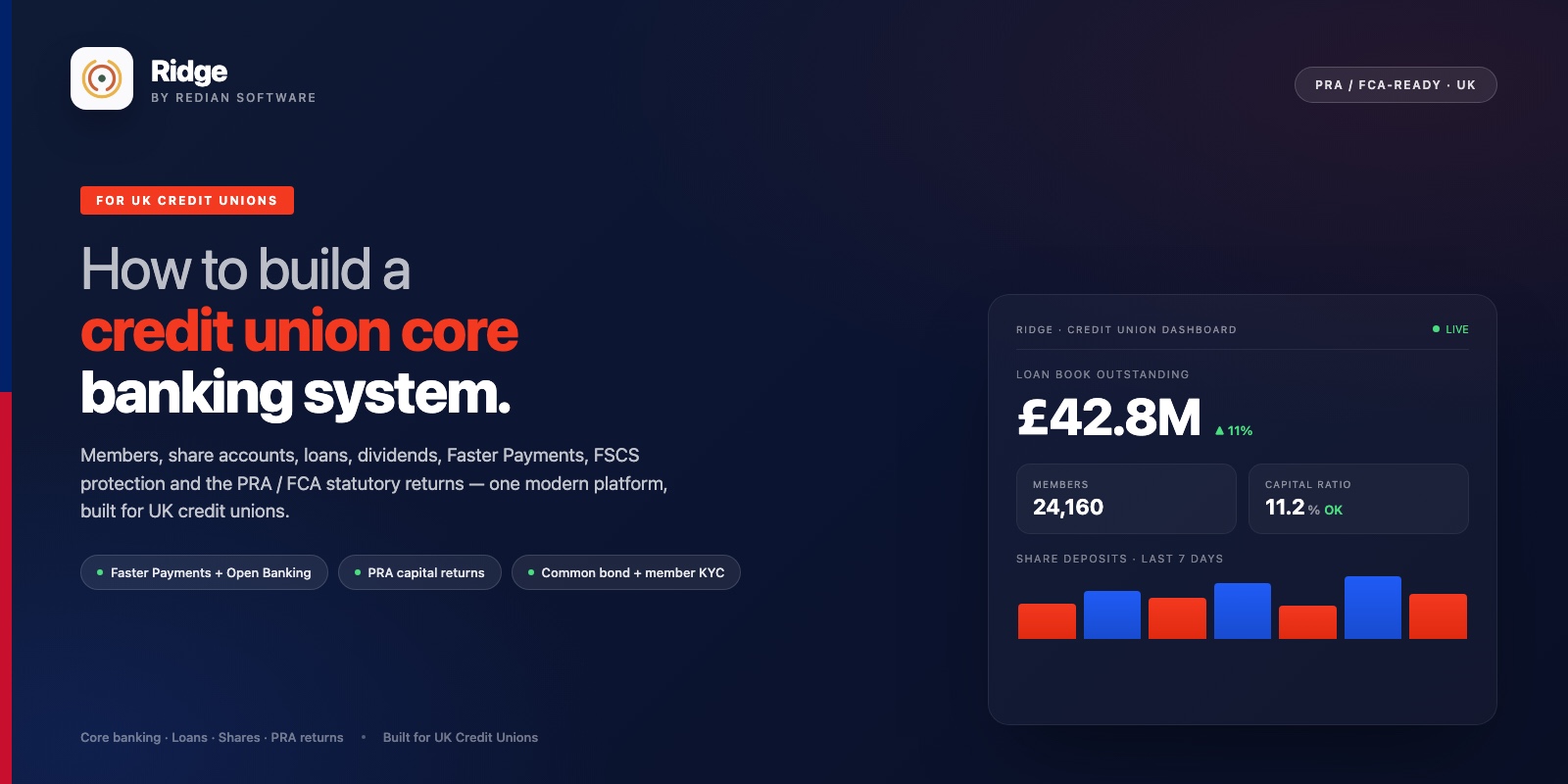
Every CEO of a UK credit union has, at some point, sat through the same budget conversation. The legacy core system is out of support, the vendor roadmap stopped moving, and the mobile app that members actually want to use costs more than the credit union's annual surplus. Meanwhile, the Prudential Regulation Authority (PRA) tightens its CRED sourcebook expectations year on year, members expect Faster Payments and Open Banking out of the box, and the operations team is still exporting a CSV every Friday to reconcile the share balances with the General Ledger.
Replacing a credit union core banking system is one of the highest-stakes technology decisions a mutual will ever make. This guide walks through how to actually do it — the modules, the regulators, the integrations, the architecture choices, the phased delivery plan, and the pitfalls that put most core-banking programmes six months behind schedule before they ship a single transaction.
A UK credit union core banking system must handle the full member lifecycle (common bond eligibility, KYC, share accounts, payroll deductions), the lending book (unsecured, deposit-backed, car and home-improvement loans with APR and PRA-aligned provisioning), the General Ledger (double-entry with fiscal periods and reversal audit), the UK payment rails (Faster Payments, BACS, Direct Debit, Open Banking), and the PRA and FCA statutory returns (CY, Credit Union Monthly, FSCS single customer view) — all against a shared transactional system of record, not a stack of spreadsheets.
Why UK Credit Unions Are Replacing Their Core Systems Right Now
The pressure to modernise is not theoretical. Four forces are hitting at the same time.
- PRA and FCA expectations keep tightening. The CRED sourcebook, FSCS single customer view obligations, Consumer Duty, and the quarterly / monthly return cycle together assume you can produce auditable, member-level data in a timeframe that spreadsheet-driven credit unions simply cannot hit.
- Member expectations have changed permanently. A member who banks with Monzo, Starling or any high-street app will not accept a credit union mobile experience that is three generations behind. Faster Payments, Open Banking data pulls, mobile loan applications, instant balance queries — these are table stakes, not differentiators.
- The legacy vendor market is thinning. Several of the historic UK credit union core providers have been acquired, consolidated, or stopped meaningful investment. Boards are being quoted end-of-life dates for software that still runs the entire operation.
- The economics of mutuals demand a lower cost-to-serve. Credit unions compete on member outcomes, not margin. Every pound spent on reconciling spreadsheets is a pound not returned as a dividend or lent out to members. A modern core system is a strategic investment in cost-to-serve, not an IT line item.
What a UK Credit Union Core Banking System Must Actually Do
A credit union is not a bank, and a general-purpose core banking platform ported from a European retail bank will not fit. The primitives are different: members (not customers), shares (not deposits in the retail-bank sense), dividend (not interest paid), common bond (not open-market acquisition), payroll deduction (not direct debit as the primary rail). Any system you build or buy must model these natively.
- Members and common bond — Individual, joint and corporate members with the full lifecycle (application → eligibility check against the common bond → KYC → approve → dormant → exit). Nominees, beneficiaries, signatories. Biometric and ID verification hooks (Yoti, Onfido, GBG). Common bond rules enforced at onboarding, not after the fact.
- Share accounts and dividend — Member share capital, regular saver, Christmas club, junior saver, fixed-term savings. Dividend calculation and distribution engine (annual or quarterly, in shares or in cash). Payroll deduction with employer bulk upload — the operational backbone of most UK credit unions.
- Loans built for credit unions — Unsecured personal, deposit-backed, car, home improvement, loyalty loans, debt consolidation. APR calculator aligned to the Consumer Credit Act, affordability assessment using Open Banking data, tranche disbursement, restructure, write-off, and PRA-aligned provisioning (not just a flat 2.5%).
- General Ledger and real accounting — Double-entry GL with fiscal periods, hard close and reversal audit. Every loan action, share transaction, dividend accrual and provision top-up generates the correct journal automatically. Trial balance that ties to the share ledger down to the penny.
- UK payment rails — Faster Payments (direct scheme or via a payment partner like ClearBank, Modulr or LHV), BACS Direct Credit and Direct Debit, standing orders, Open Banking account information services, and card issuance where the credit union has a card partner.
- FSCS single customer view — The ability to produce the FSCS single-customer-view (SCV) extract on demand, with the correct eligibility flags, compensatable balances, and member identifiers.
- PRA and FCA returns — The quarterly return (CY), the Credit Union Monthly return, capital adequacy, liquidity, large exposures, member profile, and the arrears / provisioning return — all generated from the live transactional data, not pieced together from exports.
- End-of-day automation — Nightly interest accrual, delinquency classification, provision top-ups, arrears aging. The CEO walks in to numbers that already tie out.
- Audit, RBAC and data isolation — Every change auditable. Roles inherit to individual endpoints. Member data isolated from other credit unions if the platform is shared or multi-tenant.
The UK-Specific Features Generic Core Banking Software Does Not Have
The reason a port of a European retail-bank core, or an African / Asian credit union platform, usually fails in the UK is not that the GL is wrong. It is that the specific UK primitives were never modelled.
Common Bond Eligibility Enforced at Onboarding
Every UK credit union has a common bond — occupational, residential, associational, or faith-based — defined by its rules and approved by the PRA. A new member cannot be opened unless they satisfy the bond. The core system must enforce this at the application screen, with a configurable rules engine (postcode ranges, employer lookups, association membership checks) that the credit union can update without a vendor change request.
Payroll Deduction as a First-Class Collection Rail
For most UK credit unions, payroll deduction is the single largest and most reliable share-deposit and loan-repayment channel. A core system that treats payroll as a weekly or monthly CSV import is already behind. Ridge treats payroll as its own rail: employer bulk upload, exception handling (leavers, hour reductions, overpayments), automatic allocation across member savings and loans, and auto-posting to the GL in one atomic transaction.
PRA / FCA Returns Generated From Live Data
The quarterly return (CY) and the Credit Union Monthly return are generated directly from the same transactional data that drives the GL. There is no second set of books to maintain. The FSCS single customer view is a one-click export, with eligibility flags computed from the member record rather than a side-car spreadsheet.
Faster Payments and Open Banking as Native Rails
Faster Payments is the UK's primary retail payment rail. A credit union core system that cannot send and receive FPS payments (directly or via a scheme participant) is forcing members into BACS delay and manual processes. Open Banking account information services let the credit union pull a member's current-account data for affordability assessment and arrears early-warning — a 2024 standard, not a 2026 nice-to-have.
Dividend Distribution With a Proper Audit Trail
Dividend is one of the most heavily scrutinised actions a credit union takes. The board declares it, the auditors sign off, and the member expects it in their share account on the date promised. A core system must model the declaration as a first-class event: declaration record, calculation audit (rate × average balance × days), per-member working, cash-or-shares preference, and GL postings — all reproducible months later for the auditor.
How to Build It: Build vs Buy vs Platform
| Approach | Build from scratch | Buy a legacy UK CU core | Modern cloud platform (Ridge) |
|---|---|---|---|
| Time to go-live | 18–36 months | 6–12 months of implementation | 8–16 weeks phased |
| Up-front cost | £800k–£3M | £150k–£500k setup + annual | Lower setup; monthly SaaS |
| PRA / FCA fit | Builder's responsibility | Vendor roadmap-dependent | Built-in, versioned with regulation |
| Faster Payments / Open Banking | Custom integration | Often expensive add-ons | Native |
| Mobile and web member app | Separate project | Vendor-branded or extra module | Included |
| Change velocity | Depends on team | Vendor roadmap | API-first; your team can extend |
| Data isolation | Your call | Shared schema in many cases | Dedicated schema per CU |
| Exit cost | High (your IP, but ongoing TCO) | High (lock-in) | Code and config portable |
For most UK credit unions below £1bn in assets, the honest answer is: build-from-scratch is almost never the right choice. The regulatory and payment-rail scope alone will consume a budget that would be better spent on member services. The real decision is between a legacy UK vendor on a maintenance trajectory and a modern cloud platform designed for the next decade of regulation and member expectations.
The Modern Architecture: API-First, Cloud-Native, Multi-Tenant-Isolated
A credit union core system built in 2026 does not look like one built in 2006. The architecture pattern that actually works for a mutual balance sheet has five properties.
- API-first. Every function in the core system is a documented REST API before it is a screen. The mobile app, the member web portal, Open Banking integrations, and any future partner integration all consume the same APIs the staff screens use. This is the single biggest determinant of future-proofing.
- Cloud-native, UK-sovereign. Deployed on AWS, Azure or GCP UK regions. Primary and backup in-country. No member PII leaves the UK data boundary for processing. Backups encrypted, versioned, and tested quarterly.
- Multi-tenant with per-tenant data isolation. Credit union data lives in a dedicated schema or dedicated database — not co-mingled with other credit unions in a shared table. A query from one credit union cannot reach another's data at the driver level.
- Event-sourced for audit. Every state change is an immutable event. Reversals create a new event, not a mutation. The audit trail is a byproduct of the architecture, not an add-on.
- Observability as a feature. The CEO and operations team see system health, EOD status and transaction volumes in a dashboard, not through a support ticket to the vendor.
A Phased Delivery Plan That Actually Ships
The programmes that fail are the ones that try to migrate everything on day one. The ones that ship break the work into phases a board can actually fund and sign off.
- Phase 1 — Workspace and reference data (weeks 1–3). New tenant provisioned, chart of accounts configured, loan products set up, share product rules, common bond rules, employer master. Done before a single transaction is migrated.
- Phase 2 — Member migration (weeks 4–7). Member records migrated in slices with reconciliation reports after each slice. Shares, loans, and open applications migrated against the live legacy system as a shadow run.
- Phase 3 — Operational cutover (weeks 8–12). EOD runs on both systems in parallel for two weeks. Dividends and provisions tie out. Staff trained on the new workflow. Cutover weekend with a documented rollback plan.
- Phase 4 — Member channels and payment rails (weeks 12–16). Member mobile app and web portal go live. Faster Payments and Open Banking enabled. Payroll files cut over from the old system.
- Phase 5 — Regulatory returns and dividend engine (ongoing). The first full quarterly return (CY) runs from the new system. The first dividend declaration is produced with an audit trail. The programme is complete.
Risk, Governance and Security
A core banking programme that does not have risk and compliance embedded from week one will fail an audit before it ships. Four non-negotiables.
- PRA engagement up-front. The PRA expects notification of material changes to a credit union's core operating system. Engage early, share your migration plan, and run through the risk-register with your supervisor.
- Data protection impact assessment (DPIA). Required under UK GDPR for a change of this scope. Covers data minimisation, cross-border transfers (there should be none), vendor processing, and member rights.
- Operational resilience. The FCA's operational resilience framework applies: identify important business services, set impact tolerances, and prove the new core system meets them under stress.
- Cyber security baseline. Encrypted in transit and at rest, SSO with MFA for staff, role-based access control, penetration testing before go-live, and ongoing vulnerability management. For UK credit unions, Cyber Essentials Plus is the floor.
Who Is Behind Ridge for Credit Unions
Ridge is the cloud credit union core banking suite built by Redian Software, engineered from the ground up for member-owned financial institutions and mutuals. The same platform that today runs 50+ SACCOs and MFIs on the African continent is being deployed for UK credit unions with the PRA / FCA regulatory layer, FSCS single-customer-view, Faster Payments and Open Banking integrations added as first-class capability. Every tenant gets its own dedicated database schema; nothing is shared across credit unions.
The engineering team is CMMI Level 3 appraised, with a track record of regulated-financial-services deployments across the UK, Europe, Middle East, Africa and India. Redian's broader enterprise CRM and ERP implementation and custom software development practices back the credit union programme with the full-stack capability a mutual needs for a once-in-a-decade transformation.
Start With a Walkthrough, Not an RFP
The quickest way to pressure-test whether a modern cloud core banking platform is right for your credit union is a two-hour walkthrough of the live system against your own balance sheet. Bring your CY return, your dividend policy, your common bond rules, your payroll employer list, and your current provider's end-of-life letter — and we will show you exactly how the member lifecycle, loan book, share accounts and PRA / FCA returns look on Ridge.
Book a UK credit union architecture walkthrough with Redian Software — one of our regulated-finance architects will walk your current operations, scope a phased migration, and send a written proposal with named consultants, phased costs and a target go-live date.
Frequently asked questions
- What modules does a UK credit union core banking system actually need? +
- At minimum: members and common bond management, share accounts and dividend engine, loan origination and servicing (unsecured, deposit-backed, car, home-improvement), double-entry General Ledger, payroll deduction, Faster Payments and BACS / Direct Debit, Open Banking integration, FSCS single customer view, PRA quarterly return (CY), Credit Union Monthly return, end-of-day automation, and audit / RBAC.
- Is it cheaper to build a credit union core banking system from scratch or buy a platform? +
- For almost every UK credit union below £1bn in assets, buying or subscribing to a modern cloud platform is dramatically cheaper and faster than building. A build typically runs £800k–£3M and 18–36 months before go-live; a modern cloud platform like Ridge is 8–16 weeks phased and shifts to a monthly SaaS cost model. The build-vs-buy maths only tips toward build at very large scale with highly idiosyncratic requirements.
- How does a modern core banking system handle PRA and FCA statutory returns? +
- The quarterly return (CY), Credit Union Monthly return, and the FSCS single customer view are generated directly from the same transactional data that drives the General Ledger. No side-car spreadsheets, no re-keying. The returns are versioned so a return filed in January is reproducible six months later for an audit.
- What does Faster Payments and Open Banking integration mean for a credit union? +
- Faster Payments lets members move money in and out in seconds rather than wait for BACS cycles — critical for member retention. Open Banking account information services let the credit union pull a member's current-account data (with consent) for affordability assessment at loan application and for arrears early-warning. Both should be native to any modern core system, not expensive add-ons.
- How is member data kept isolated from other credit unions on a shared platform? +
- On Ridge, every credit union gets its own dedicated database schema. Connections route on tenant id at the database driver level, so a query from one credit union cannot reach another credit union's data even in the unlikely event of an application bug. UK data stays in a UK-sovereign cloud region.
- What is the realistic timeline to migrate off a legacy credit union core system? +
- A well-scoped migration lands in 12–16 weeks: 3 weeks for workspace and reference data, 4 weeks for member and loan migration with slice-by-slice reconciliation, 4 weeks of parallel EOD runs and operational cutover, then 4 weeks for member channels (mobile app, Faster Payments, Open Banking) and payroll cutover. The first full regulatory return runs from the new system in the quarter after cutover.
- What regulatory engagement is required before changing a core banking system? +
- The PRA expects notification of material changes to a credit union's core operating platform. Engage your supervisor early, share the migration plan, DPIA, operational resilience assessment and risk register. The FCA's operational resilience framework also applies: identify important business services, set impact tolerances, and prove the new system meets them. Cyber Essentials Plus is the baseline cyber control standard.
Stay current with our insights
One monthly email. Banking, insurance, AI/ML and CRM field notes. No spam.
We respect your privacy. Read our Privacy Policy.
Keep reading
More from Banking & Finance
Banking & Finance
Ridge: A Cloud Core Banking Suite for Ethiopian SACCOs and MFIs
Ridge is a cloud-based core banking suite designed for Ethiopian SACCOs and MFIs — members, loans, guarantors, savings, dividends, double-entry accounting, telebirr collections and NBE / ECC statutory returns in one system, with your own MySQL schema.
27 Oct 2026

Insights
Why Enterprises in UK are choosing Kenya for their Call Centre Support
UK enterprises are moving voice, email and chat support to Nairobi in growing numbers — 2-3 hours ahead of London, natively English-speaking, UK-GDPR-aligned data protection, and unit economics 60-70% below a comparable UK contact centre. Redian Software runs a Nairobi-based call centre support hub built for exactly this footprint.
30 Jul 2026

Zoho
Hire Remote Zoho Developers for US Companies — With an Experienced Zoho Partner Team
A dedicated remote Zoho development team — Zoho-certified, Zoho-partnered, and set up to work US business hours — treats your Zoho stack as a product it owns and ships against. Here's how to hire one, what it covers, and how it compares to a freelancer or on-shore agency.
27 Oct 2026
Build with Redian
Have a similar build in mind?
We've shipped banking & finance systems for banks, insurers, brokers, MFIs, SACCOs and enterprises across the USA, UK, Africa, UAE and India. Book a 30-min call with a senior engineer — no pitch deck, just a sharp first read on your initiative.
- CMMI Level 3 Appraised · ISO Certified delivery
- 1 business day response · NDA on request
- Senior engineers, not sales — first call