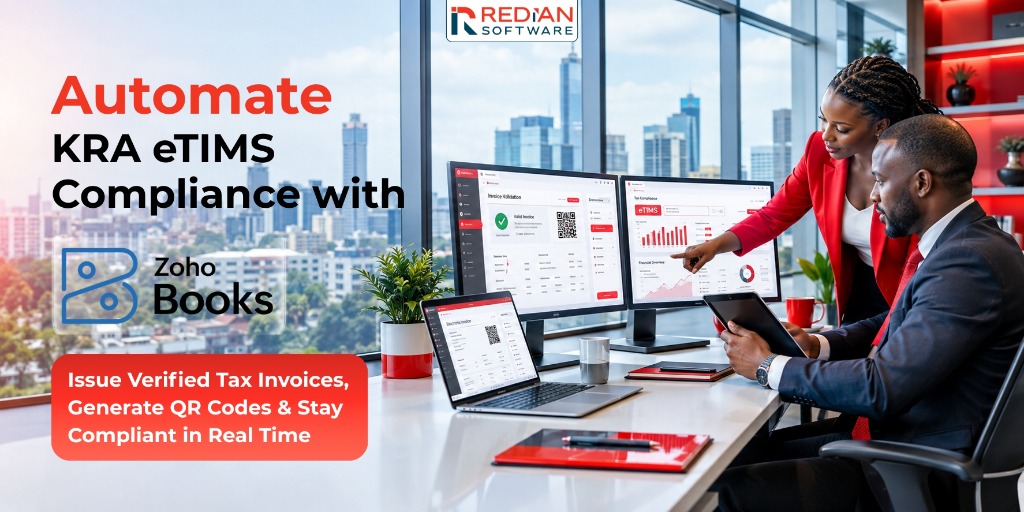
Zoho Books and KRA eTIMS Integration: What Kenyan Businesses Need to Know
Zoho Books connects directly to KRA eTIMS via the Online Sales Control Unit (OSCU) — validate customer PINs, generate QR-coded tax invoices and transmit to KRA in real time. A step-by-step setup guide for Kenyan businesses from an accredited Advanced Zoho Partner.
Zoho Books and KRA eTIMS Integration: What Kenyan Businesses Need to Know
Kenyan corporate leaders and finance directors operate in an environment where tax technology is mandatory.
Under Section 23A of the Tax Procedures Act, every commercial entity must issue verifiable digital invoices. Achieving reliable KRA eTIMS integration is essential for organizations seeking to protect corporate tax deductions, maintain steady cash flow, and avoid statutory penalties.
Deploying eTIMS-compliant accounting software enables finance teams to eliminate manual logging while keeping records synchronized with the tax authority.
When implementing a Zoho Books eTIMS integration, finance leaders connect their billing and ledger systems directly to the Kenya Revenue Authority.
As an accredited Advanced Zoho Partner honoured as the Zoho Emerging Partner of the Year for East Africa and winner of the Zoho Key Business Contributor Kenya Award, Redian Software provides certified enterprise deployment services.
This guide outlines the architecture, setup sequence, and operational practices necessary to sustain complete KRA e-invoicing compliance.
What Is KRA eTIMS and Why Is Integration Mandatory for Kenyan Businesses?
KRA eTIMS is the electronic Tax Invoice Management System introduced by the Kenya Revenue Authority to replace standalone Electronic Tax Register (ETR) hardware. The system captures transaction records at the point of sale and transmits invoice information to KRA servers instantly, validating business expenditures and Value Added Tax claims.
The regulatory shift accelerated following the gazettement of the Tax Procedures (Electronic Tax Invoice) Regulations. As outlined in the official KRA eTIMS regulatory guidelines, all business entities, including non-VAT registered businesses, must channel transactions through eTIMS.
Under Section 16 of the Income Tax Act, documented on Kenya Law judicial portals, corporate expenditures are deductible for tax purposes only when supported by a valid electronic tax invoice.
- Expense Disallowance Risks: Corporate clients cannot claim income tax deductions on operational purchases unless supplier invoices display an authenticated KRA QR code and CUIN.
- Strict Input VAT Validation: VAT-registered taxpayers can claim input tax deductions only when supplier transactions match real-time entries on the central KRA portal.
- Elimination of Hardware Failures: Physical Type D ETR machines require maintenance, paper ribbons, and physical SIM cards. Software connections eliminate physical equipment downtime.
- Elimination of Ledger Discrepancies: Manual reconciliation between standalone billing tools and tax filing systems introduces human error that triggers compliance reviews.
How Does Zoho Books Connect to KRA eTIMS? (OSCU vs. VSCU Explained)
Zoho Books connects to KRA eTIMS through the Online Sales Control Unit (OSCU) standard. While the Virtual Sales Control Unit (VSCU) requires dedicated on-premise servers for offline caching, OSCU establishes a direct cloud API handshake with KRA servers to sign transactions instantaneously.
Choosing between OSCU and VSCU depends on your infrastructure model, transaction volume, and connectivity profile. Here is how both integration mechanisms compare:
| Architecture Feature | Online Sales Control Unit (OSCU) | Virtual Sales Control Unit (VSCU) |
|---|---|---|
| Deployment Environment | Cloud SaaS (built into Zoho Books) | On-premise servers or dedicated virtual machines |
| Hardware Requirements | None; operates over standard internet connection | Requires local server host, static IP, and daemon service |
| Rollout Complexity | Fast setup using digital serials and pairing keys | Requires custom middleware setup and server maintenance |
| System Updates | Automated background updates managed in the cloud | Requires periodic manual patches and security updates |
| Target Organizations | Consulting, distribution, tech firms, and SMEs | High-volume supermarket chains and offline retail cashiers |
For organizations running Zoho Books cloud accounting, OSCU provides the most reliable architecture. It removes infrastructure maintenance while enabling a certified electronic tax invoice management system integration.
When enterprises require bespoke billing engines, custom warehouse connections, or legacy database sync, Redian Software creates robust middleware using our custom software development services.
How to Set Up Zoho Books KRA eTIMS Integration: 5-Step Implementation Guide
Setting up eTIMS in Zoho Books involves generating a cloud Device Serial Number, submitting an OSCU service request on the KRA portal, authenticating with digital pairing keys, and conducting sandbox verification before issuing live invoices.
To ensure a smooth transition, follow this technical implementation workflow:
Step 1: Verify Organizational Profiles and Tax Obligations
Confirm that your business possesses an active KRA PIN with the required tax obligations (Income Tax and VAT where registered). Review your organization profile inside Zoho Books to verify that legal business names, physical street addresses, and tax identification numbers match your KRA registration certificate precisely.
Step 2: Generate Device Serial Number in Zoho Books
Access Settings > Taxes & Compliance > e-Invoicing within your Zoho Books administrative console. Enable the Kenya eTIMS compliance module and select your primary operating branch. Click Generate Device Serial Number to produce your cloud organization\'s unique digital identifier.
Step 3: Submit OSCU Service Request on the KRA Portal
Sign in to the official Kenya Revenue Authority portal at KRA eTIMS Taxpayer Portal. Open Service Request and select eTIMS. Choose OSCU as your designated solution type. Submit your Zoho Device Serial Number, operational branch designation, and contact details for official KRA validation.
Step 4: Authenticate with Integration Security Tokens
Once KRA approves the service request, an activation token is issued. Enter this cryptographic key into the Zoho Books e-Invoicing console. The system performs an encrypted TLS handshake to establish a secure transmission pipe between Zoho Books and KRA servers.
Step 5: Run Sandbox Test Invoices and Go Live
Review technical specifications on the Zoho Books official documentation portal. Create a test invoice to confirm that transaction payloads transmit cleanly, receive a Control Unit Invoice Number (CUIN), and render a valid scannable QR code on the final PDF before switching on live production billing.
How Does Zoho Books Handle Real-Time Tax Invoicing and QR Code Validation?
When an invoice is approved in Zoho Books, the platform pushes a formatted JSON payload to the KRA OSCU service. The tax authority validates the payload, applies a digital signature, assigns a CUIN, and generates a verification link embedded into a dynamic QR code on the client invoice PDF.
This automated sequence ensures that sales staff can issue invoices without manual intervention. Below is the operational lifecycle of real-time tax invoice transmission:
| Stage | Action in Zoho Books | eTIMS Statutory Validation Output |
|---|---|---|
| 1. Draft Creation | Sales staff enters line items, quantities, prices, and buyer KRA PIN. | Pre-validation verifies mandatory fields, item tags, and VAT rates. |
| 2. Cloud Transmission | User clicks Approve or Send. Zoho Books pushes encrypted payload to KRA. | KRA gateway authenticates device serial and buyer PIN status. |
| 3. Digital Signing | KRA server logs transaction, generates digital signature and CUIN. | Invoice is stored in central tax ledger; public validation URL generated. |
| 4. PDF Generation | Zoho Books embeds CUIN and high-resolution QR code onto client PDF. | Customer scans QR code to verify authenticity directly on KRA servers. |
Managing credit notes, debit notes, and invoice cancellations follows a similar process. KRA regulations require credit notes to reference the original CUIN of the invoice being adjusted.
In Zoho Books, credit notes created against existing invoices automatically inherit the original CUIN, guaranteeing that tax adjustments balance across both seller and buyer accounts.
What Are the Common eTIMS Implementation Pitfalls and How Can You Avoid Them?
Common implementation challenges include item classification errors, unvalidated buyer PINs, multi-branch device misconfigurations, and lack of offline queue handling. Establishing proper data hygiene before launch eliminates transmission errors.
- Item Classification and Tax Code Mismatch: KRA requires item descriptions to align with recognized classification codes. If standard-rated items are mistakenly categorized as exempt or zero-rated, KRA systems will flag the invoice during reconciliation. Audit your Zoho Books product catalog to ensure tax rates are configured accurately.
- Invalid Customer PIN Formats: Submitting B2B invoices with incorrect PIN structures causes instantaneous transmission failures. Ensure your sales team verifies corporate customer PINs and validates tax records before generating invoices.
- Branch Profile Misconfiguration: Enterprises with multiple retail outlets or distribution depots often attempt to use a single device serial number across all locations. KRA expects distinct device profiles for separate branches. Set up individual branch profiles in Zoho Books to maintain clean geographic reporting.
- Connectivity Interruption Management: While cloud connections are resilient, local internet drops can interrupt real-time posting. Zoho Books features automated transaction queues that buffer unposted invoices and submit them automatically once network connectivity is restored.
Real-World Case Studies: How Kenyan Enterprises Scale with Zoho and Redian Software
Kenyan enterprises across manufacturing, logistics, and regional research achieve tax compliance and operational speed by pairing Zoho applications with Redian Software implementation engineering.
Redian Software has delivered comprehensive CRM & ERP implementations across East Africa. To review our proven regional track record, explore our enterprise case studies directory.
Three key client transformations highlight how automated finance systems drive efficiency:
Case Study 1: Axxon Streamlines Manufacturing Workflows and Accounting
Axxon, a notable manufacturing enterprise, struggled with disconnected inventory records, fragmented bills of materials, and slow monthly reconciliations.
Redian Software implemented Zoho Books connected with customized production workflows. The deployment established real-time cost accounting, automated invoicing, and simplified tax tracking.
As a result, Axxon reduced month-end closing cycles by 40% and eliminated duplicate data entries across its production units.
Case Study 2: Samuel Hall Unifies Multi-Country Finance and Operations
Operating across East Africa, Central Asia, and Europe, social research organisation Samuel Hall required unified multi-currency accounting that complied with regional statutory guidelines.
Redian Software deployed Zoho One with Zoho Books serving as the central accounting engine. The platform streamlined project accounting, multi-currency ledger conversions, and audit-ready tax reporting, reducing administrative finance overhead by 35%.
Case Study 3: Nellions Movers Integrates Zoho One ERP for Fleet and Invoicing
Nellions Movers, a leading moving and logistics enterprise in Kenya, required direct integration between its proprietary Move Yetu booking portal and back-office accounting.
Redian Software connected their operations platform with Zoho Books. Client quotes convert into validated invoices automatically with embedded tax identifiers and automated M-Pesa payment sync, saving dozens of manual accounting hours each week.
How Does Zoho Books Compare with Legacy ETR Machines and Traditional Accounting Tools?
Zoho Books delivers native cloud accessibility, direct OSCU eTIMS transmission, automated bank feeds, and seamless business app integrations. Traditional hardware ETRs and legacy desktop tools require physical upkeep, manual keying, and fragmented ledgers.
| Key Capability | Zoho Books Cloud Accounting | Traditional Hardware ETR | Legacy Desktop Accounting (e.g. QuickBooks Desktop) |
|---|---|---|---|
| eTIMS Integration | Native direct cloud OSCU transmission | Hardware-bound Type D memory register | Requires external third-party bridge |
| QR Code on Invoices | Rendered automatically on customer PDFs | Printed on thermal register tape only | Requires custom scripting or manual print |
| Bank & M-Pesa Feeds | Automated bank feeds and M-Pesa API sync | None; requires manual journal entry | Manual monthly CSV spreadsheet import |
| Multi-Currency Support | Live exchange rates and currency gains | Limited to local currency only | Requires manual exchange rate adjustments |
| Remote Team Access | Full web and mobile application access | Stationed physically in office premises | Tied to local office network server |
| Ecosystem Integration | Native links to CRM, Desk, and Inventory | Standalone hardware terminal | Complex database import and export routines |
Why Partner with Redian Software for Your Zoho Implementation?
Transitioning to automated financial compliance requires reliable software engineering and practical regional knowledge. As a CMMI Level 3 appraised IT consultancy and certified Zoho Consulting and Implementation Specialist, Redian Software provides local expertise backed by global delivery standards. Our services include:
- End-to-End eTIMS Deployment: Configuring OSCU connections, device pairing, branch tax profiles, and live invoice validation.
- Legacy Accounting Migration: Seamlessly transferring customer accounts, chart of accounts, and opening balances from QuickBooks, Sage, Xero, or spreadsheets.
- Local Financial Integrations: Building direct connections for M-Pesa Daraja API, Pesapal, core banking databases, and custom ERP workflows through our CRM and ERP implementation specialists.
- Comprehensive Staff Training & Support: Delivering hands-on training for finance directors, accountants, and sales teams from our Nairobi hub.
For SACCOs, microfinance institutions, and insurers, we also provide specialized BFSI software solutions and automated loan management systems that connect directly into general ledgers.
Frequently Asked Questions About Zoho Books and KRA eTIMS Integration
What is the primary difference between eTIMS and older TIMS ETR machines?
TIMS (Tax Invoice Management System) relied on physical Type D Electronic Tax Register hardware with embedded memory and cellular SIM cards. eTIMS (electronic Tax Invoice Management System) is an entirely software-driven architecture that allows accounting software like Zoho Books to send signed transaction payloads directly to KRA endpoints via standard internet protocols.
Is eTIMS integration mandatory for non-VAT-registered businesses in Kenya?
Yes. Under Section 23A of the Tax Procedures Act, all business entities operating in Kenya must onboard onto eTIMS and issue electronic tax invoices, regardless of VAT registration status. While non-VAT businesses do not charge 16% VAT, corporate clients cannot claim income tax deductions for business expenses without valid eTIMS invoices.
Can small businesses configure Zoho Books for eTIMS without purchasing servers?
Yes. Zoho Books operates using the Online Sales Control Unit (OSCU) standard, which is completely cloud-hosted. Organizations require only an active Zoho Books subscription, an internet connection, and an approved KRA service request. No local hardware servers or physical controllers are needed.
What happens to pending customer invoices if internet connectivity drops?
Zoho Books queues outgoing invoices within its secure database. As soon as network connectivity is re-established, the platform transmits queued transactions to KRA endpoints, retrieves the assigned CUINs and validation keys, and updates invoice statuses automatically.
How does Zoho Books handle Kenyan VAT returns and withholding tax tracking?
Zoho Books categorizes standard-rated, zero-rated, and tax-exempt transactions automatically. At month-end, finance teams generate tax summary reports that reconcile directly with KRA filing schedules. Furthermore, withholding tax and withholding VAT deductions are tracked directly against customer receipts.
Can we connect Zoho Books with Safaricom M-Pesa Paybill and Till numbers?
Yes. Redian Software configures automated integrations between Zoho Books and the Safaricom Daraja API. Customer payments sent to your Paybill or Buy Goods Till reconcile against open invoices automatically, marking them as settled and updating general ledgers in real time.
Ready to Automate Your KRA eTIMS Invoicing with Zoho Books?
Set up your verified cloud accounting system today. Create your official Zoho Books account through our authorized partner portal:
Sign up for Zoho BooksSchedule a Consultation with our Nairobi Team
Stay current with our insights
One monthly email. Banking, insurance, AI/ML and CRM field notes. No spam.
We respect your privacy. Read our Privacy Policy.
Keep reading
More from Zoho
Zoho
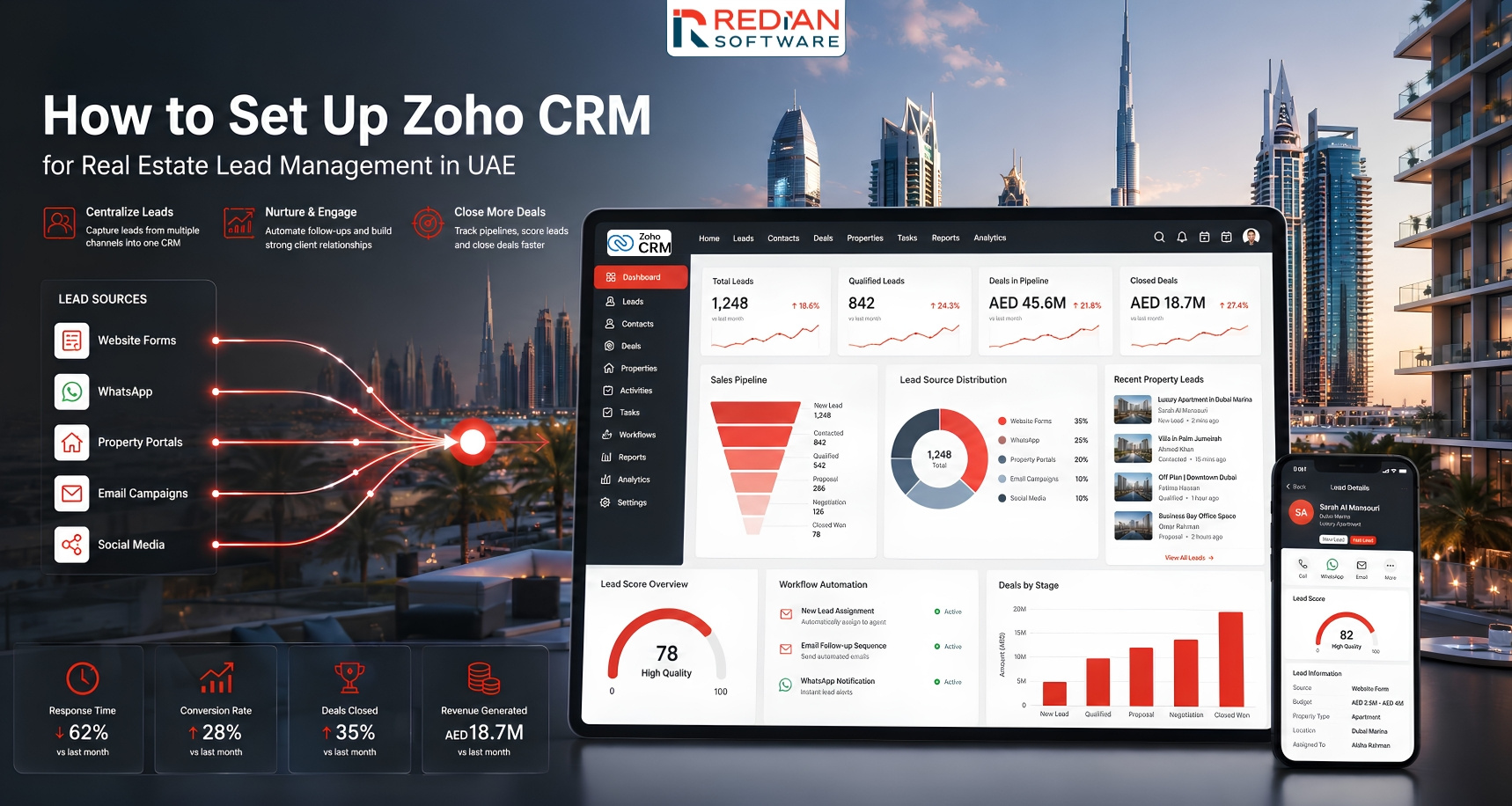
How to Set Up Zoho CRM for Real Estate Lead Management in UAE
A practical implementation guide for UAE brokerages using Zoho CRM for real estate, built on Redian Software's hands-on deployment experience across Africa, the UK, India and the US.
17 Sept 2026

Zoho
Build to Last. One System — Zoho for Real Estate Developers
A three-part masterclass on unifying construction management, multi-channel sales, and post-handover property operations on one Zoho stack — with revenue-leakage safeguards CFOs actually trust.
04 Sept 2026
Zoho
End-to-End Xero to Zoho Books Migration Service by Redian Software
Redian handles your Xero → Zoho Books migration end-to-end — scoping, data mapping, historical migration, integrations, parallel run, cutover and hypercare. Fixed-fee, zero downtime, delivered by an Advanced Zoho Partner.
09 Jul 2026
Build with Redian
Have a similar build in mind?
We've shipped zoho systems for banks, insurers, brokers, MFIs, SACCOs and enterprises across the USA, UK, Africa, UAE and India. Book a 30-min call with a senior engineer — no pitch deck, just a sharp first read on your initiative.
- CMMI Level 3 Appraised · ISO Certified delivery
- 1 business day response · NDA on request
- Senior engineers, not sales — first call