
Why Kenyan Enterprises Should Build a Captive Centre in India — Managing Cost and the Skilled-Talent Shortfall
Why Kenyan banks, insurers, manufacturers and FMCG leaders are standing up captive centres in India — the Nairobi engineering-talent shortfall, the cost arithmetic, the sustained-capability advantage and the Build-Operate-Transfer path to get there in 90 days.

Every Kenyan bank CIO has run the same maths at least once. The three-year engineering hiring plan priced out of Nairobi — 30 FTEs across backend, data, DevOps and BFSI QA — comes back at a number the board quietly pushes back on. The local talent market is thin, the salary inflation for a mid-career Java or Flutter engineer is running ahead of the lending book, and the consultancies quoting against the gaps are 2x what the internal plan needed.
Then someone on the exec team suggests "what about an India offshore team?" — and the room splits between those who remember a bad experience with an agency a decade ago and those who have been hearing their peers at Safaricom, Equity, KCB, NCBA, Jubilee and British American Tobacco have quietly set up captive centres in Noida, Bengaluru or Pune and are shipping production software out of them every week.
This guide is for the Kenyan executive team weighing that decision. A captive centre is not an outsourcing contract. It is a dedicated engineering and operations unit — your brand, your IP, your employees in effect — hosted in India under a legal and operational wrapper that lets you scale without having to become an Indian HR company overnight.
A captive centre is a dedicated offshore business unit, staffed by permanent engineers, data analysts, operations specialists and domain experts in India, operating under the parent Kenyan enterprise's brand, security policies and governance — delivering core technology, analytics, finance and operations capacity at 50–70% below the fully-loaded Nairobi cost base, with none of the IP leakage or vendor-management overhead of an outsourcing contract.
Why Kenyan Enterprises Are Looking at India Captive Centres Right Now
The pattern is familiar across BFSI, insurance, manufacturing and FMCG boards in Nairobi. Four pressures are hitting simultaneously.
- The Kenyan engineering talent market cannot keep up with demand. Salary inflation for mid-career Java, Flutter, DevOps and data engineers in Nairobi is running 20–25% year-on-year. Senior ML and platform engineers are being hired away by regional fintechs and global remote firms paying in dollars. Enterprise IT roadmaps that assumed a stable talent cost base are coming apart.
- Digital transformation budgets are not flexing upward. CBK, IRA and KEBS compliance expectations keep expanding; Open Banking, FOS, e-invoicing and eTIMS are all adding engineering load. The CFO is not approving a proportional budget increase.
- Peers have already proven the model works. The top-tier Kenyan banks, insurers, manufacturers and consumer-goods companies have quietly built or begun building captive centres in India over the past 36 months. The playbook is now reference-able and the execution risk is well-understood.
- India's GCC supply side is now mature for African clients. Twenty years ago, India captive centres served US and European parents almost exclusively. In the past five years the supply side — co-working campuses, HR vendors, payroll processors, compliance firms, BOT partners — has matured specifically for mid-market international clients that need 30–200 FTEs, not 2,000.
The last point matters most. A Kenyan bank with a 40-seat captive plan does not need to behave like Barclays setting up a 3,000-seat centre. The build is weeks, not years, when you partner with someone who runs the HR, payroll, compliance and office wrapper and transfers it to you later.
Which Kenyan Enterprises Should Seriously Consider This
A captive centre is overkill below a certain scale and under-tooled above another. The sweet spot for Kenyan enterprises starts at about 20 sustained FTEs of offshore capability and runs up to several hundred.
- Tier 1 and Tier 2 Kenyan banks. Core-banking modernisation, mobile and USSD channels, Open Banking APIs, data warehousing, fraud and AML analytics, CBK regulatory reporting — these are permanent engineering workloads, not projects. The commercial banking groups (Equity, KCB, Co-op, NCBA, Absa Kenya, Stanbic, I&M, DTB) all have engineering queues deeper than the local market can staff.
- Kenyan insurance groups. General, life and health insurers running on legacy policy admin platforms (Policy Admin, Majesco, Insure MO, custom-built) need a sustained engineering capability for modernisation, actuarial data engineering, claims automation, agent portals, regulatory returns to the IRA. Jubilee, Britam, CIC, UAP Old Mutual and APA all sit in this profile.
- Large Kenyan manufacturers. Steel, cement, agro-processing, packaging and chemicals groups running SAP or Oracle ERPs with aging customisations, OT/IT integration, MES modernisation, procurement analytics and shop-floor digital systems. Bamburi, East African Breweries, Mabati Rolling Mills, Bidco — the IT backlog is the gating item for the operational transformation.
- Kenyan FMCG and consumer goods. Distribution analytics, trade-marketing platforms, e-commerce and D2C channels, loyalty, route-to-market systems, Zoho / SAP / Microsoft Dynamics customisation. Unilever Kenya, EABL, Brookside, BAT Kenya, Chandaria Industries — the data-and-digital teams are consistently under-resourced.
- Kenyan telcos and digital-financial-services players. Safaricom, Airtel Kenya and the MNO-adjacent fintechs — the engineering demand is permanent and regional.
If you employ fewer than about 500 people total or your IT team is below 10 people, outsourcing or a managed-services relationship is almost certainly a better fit than a captive. Everyone else should run the maths.
What a Captive Centre Actually Delivers — And What It Does Not
Before the entity structuring and the real-estate choices, be precise about scope. The capability set that actually transplants well to a dedicated India team runs across four lanes.
- Software engineering. Backend services (Java, .NET, Node, Python, Go), mobile (iOS, Android, Flutter, React Native), web (React, Angular, Vue), APIs, middleware and the custom code that holds your digital stack together.
- Data and analytics. Data engineering (Snowflake, Databricks, BigQuery, Azure Synapse), BI and visualisation (Power BI, Tableau, Looker), ML and data-science teams for fraud, pricing, risk and churn models.
- Operations and ITES. Finance-and-accounting (reconciliation, AP/AR, statutory reporting), KYC and onboarding ops, claims processing, customer-service back office, regulatory-return preparation. For a bank or insurer, this is often the largest headcount and the fastest ROI.
- Specialist domains. Actuarial support, model risk, CISO / cyber operations, DevSecOps, SRE, cloud FinOps, quality and release engineering, compliance and audit support.
What a captive centre is not: a cheap consulting shop. The economics only work if the team is permanent, embedded in the parent's operating model, and treated as a first-class delivery unit — not a cost-cut bodyshop.
How a Kenyan Captive Centre in India Compares to the Alternatives
| Dimension | Hire in Nairobi | Outsource to an India IT firm | Captive centre in India |
|---|---|---|---|
| Fully-loaded cost / FTE | 100% baseline | 50–70% of Nairobi | 30–45% of Nairobi (sustained) |
| Time to 20 FTEs | 12–18 months (if talent available) | 6–8 weeks (shared pool) | 8–12 weeks with a BOT partner |
| IP ownership | Yours | Shared / vendor-controlled | Yours |
| Brand & culture | Yours | Vendor's | Yours |
| Team stability | High (if paid) | Low (project rotations) | High (your permanent staff model) |
| Domain depth over time | Builds in-house | Resets with every SOW | Compounds inside your team |
| Governance / data residency | Local | Contractual | Parent-controlled under policy |
| Setup effort | Standard hiring | Procurement cycle | HR / entity / compliance wrapper |
The reason mature Kenyan enterprises are moving past outsourcing and into captives is the right-hand column of that table — permanent capability, compounding domain expertise, parent IP, lower sustained cost. The captive wins on the long-run economics once the sustained headcount crosses about 20.
How to Actually Build It — The 90-Day Setup, The 6-Month Scale
A well-run Kenyan captive in India goes from decision to first live team in roughly 12 weeks, and from first team to a 30–50-FTE steady state in about 6 months. The sequence matters more than the pace.
Phase 1 — Scope and legal wrapper (weeks 1–4)
- Define the capability charter. What exactly will the India centre do, and what stays in Nairobi? Which queues, which products, which regulatory boundaries?
- Choose the entity model. Options are (a) your own India private limited company (full parent ownership, maximum control, highest setup effort), (b) a Build-Operate-Transfer arrangement where a local partner holds the entity and transfers it to you in 18–36 months, or (c) a PEO / EOR (Employer of Record) wrapper where the partner stays indefinitely as the legal employer.
- STP / SEZ / domestic. Software Technology Park (STP) and Special Economic Zone (SEZ) registrations give tax incentives for export-oriented services. For a Kenyan parent, STP is almost always the right call.
- Data residency and parent-policy conformance. Where does customer PII sit, which cloud regions are permitted, what is the inter-company data-sharing agreement? Get the DPIA done up front, not in month eight.
Phase 2 — Real estate, HR vendor, first hires (weeks 4–8)
- Co-working first. For 20–40 seats, start in a managed office campus (WeWork, Awfis, Smartworks, Innov8). Dedicated floor plates are available with 4-week fit-out. Lease a dedicated office only once you cross about 50 FTEs.
- Payroll, benefits, compliance. Partner with an India payroll and compliance vendor who handles PF, ESI, gratuity, professional tax and the statutory return cycle. This is table stakes; do not try to run it from Nairobi.
- First-wave hiring. The initial 8–12 hires are the hardest and the highest-leverage. Prioritise a senior India country lead, a tech architect and two or three lead engineers who will set the bar for everything that follows.
Phase 3 — Shadow and shift (weeks 8–14)
- Shadowing with the Nairobi team. The first production workstreams run in shadow — India engineers co-build with Nairobi leads, learn the stack, inherit the backlog over 3–6 weeks.
- Measurable transfer. Specific features, specific services, specific queues move from Nairobi ownership to India ownership with written handover notes and a two-week bedding-in period.
- First solo delivery. By week 14, the India team is shipping one or two services or workstreams end-to-end with Nairobi only on review.
Phase 4 — Scale and specialisation (months 4–6)
- Headcount ramp. Second-wave hiring brings the team to 25–50 FTEs across the full capability lanes.
- Domain specialisation. Pods form around specific business domains (retail banking, SME, cards, treasury) rather than horizontal technology layers. This is where the long-run advantage compounds.
- Governance cadence. Weekly delivery reviews with Nairobi, monthly steering with the exec, quarterly business review against the capability charter. Named owners on both sides.
Phase 5 — Transfer (months 18–36)
If the entity is held by a BOT partner, the formal transfer to the Kenyan parent happens on a scheduled date with due diligence, employee novation and asset transfer — the equivalent of a planned carve-out. If the entity is already yours, this phase is the governance-maturity milestone instead.
The India Advantage, Specifically for Kenyan Enterprises
Three things make India particularly suited to Kenyan parent companies, beyond the obvious cost arithmetic.
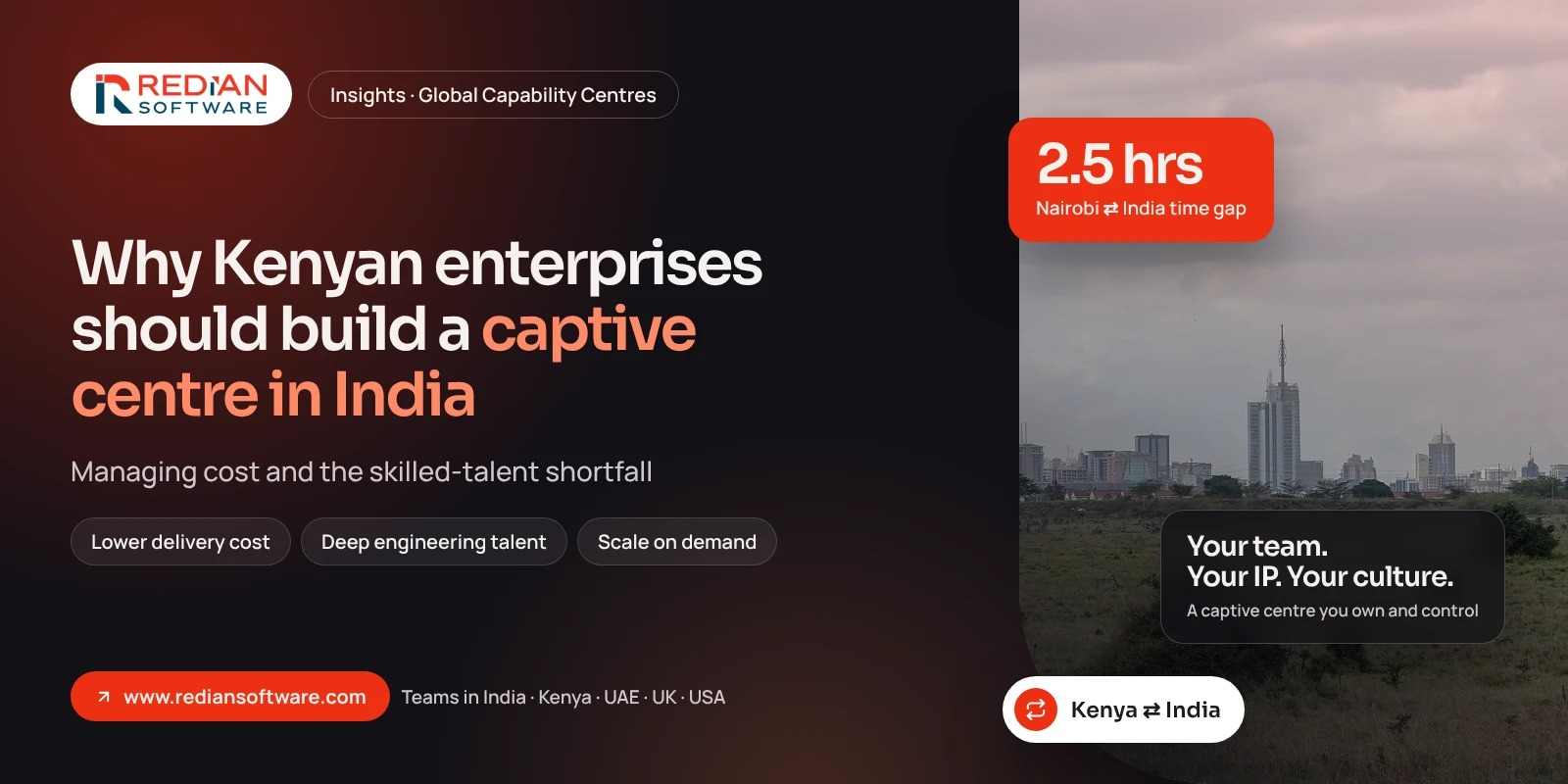
- Shared time zone that works. India is two-and-a-half hours ahead of Nairobi. Full working-day overlap every day — not the four-hour window Kenyan companies get with Europe or the two-hour window with the US. Standups, demos, incident response and leadership reviews all happen in live time, without anyone working outside their business day.
- Deep BFSI, insurance and manufacturing domain pool. India's GCC ecosystem has thirty years of banking, insurance, telecom and manufacturing engineering depth built for US and European parents. Core banking platforms (Temenos, Finacle, FIS, Flexcube, Oracle FLEXCUBE), insurance platforms (Guidewire, Insure MO, Majesco, PolicyCentre), ERP (SAP, Oracle, Microsoft Dynamics), analytics stacks and data platforms are all deeply staffed. You are not teaching engineers your sector — you are hiring engineers who already know it.
- English-language parity, written-communication maturity. English-medium education, written-first business culture, documented delivery discipline. The failure modes of offshore delivery that burned Kenyan boards fifteen years ago (comms gaps, ambiguous specs, late escalation) are now largely solved problems in the mature India GCC playbook.
What Redian Software Brings to the Build
Redian Software runs its own India delivery centre out of Noida and has shipped captive and managed-engineering engagements for BFSI, insurance, manufacturing and FMCG clients across Kenya, Uganda, Rwanda, Tanzania, the UAE, the UK and the US for over a decade. Our Global Capability Centre (GCC) practice stands up Kenyan-parent captives on a Build-Operate-Transfer basis — we hold the entity, hire the team, run payroll and compliance, deliver the initial production workstreams, and transfer the entity to the Kenyan parent when they are ready to take ownership.
What that looks like in practice:
- BOT entity wrapper. We provide the India private limited structure, the STP registration, the office, the HR and compliance vendor and the payroll — all under your brand from day one.
- Named India country lead. A senior Redian delivery leader runs the day-to-day until the transfer, acting as your country lead in India and your interface to the local operational layer.
- Named engineering pod leads. Technology leads for each lane — platform, data, DevOps, mobile, specific domain pods — recruited to your spec and embedded with your Nairobi team from week one.
- Governance cadence. Weekly delivery, monthly steering, quarterly business review — plus an annual capability review where the transfer roadmap is reset.
- Transfer on a scheduled date. The entity, the lease, the employees and the IP transfer to the Kenyan parent on a date chosen by the parent, typically between month 18 and month 36, with full due-diligence support.
The Decision Framework
A captive centre in India is the right move when four things are true: your sustained offshore demand is 20+ FTEs, your IT roadmap stretches at least 24–36 months out, you want permanent capability (not project-by-project outsourcing), and you are prepared to invest in the operating-model work of running a two-geography delivery organisation.
If those four are true, the economics are compelling, the setup window is weeks not years, and the Kenyan peers who have built one are now on their third wave of expansion. The companies that will struggle in the next five years are the ones whose engineering capacity is bottlenecked by the Nairobi talent market while their competitors are shipping from Noida and Bengaluru.
Start With a Capability Charter, Not a Headcount Target
The shortest path from "we should look at this" to a live India team is a two-session capability-charter exercise with a partner who has done it before. Bring your IT organisation chart, your three-year roadmap, your current vendor spend and the roles you cannot fill in Nairobi — we will walk you through the charter, the entity options, the BOT structure, the realistic 90-day setup plan and a transparent cost model.
Talk to Redian Software's GCC team — our Nairobi and Noida delivery leads will scope a captive build tailored to your sector, your scale and your Kenyan governance model.
Frequently asked questions
- What is a captive centre and how is it different from outsourcing? +
- A captive centre is a dedicated offshore engineering and operations unit staffed with permanent employees who work exclusively for the parent enterprise — under the parent's brand, IP, security policies and governance. Outsourcing is a vendor-delivered service against a contract. Captives compound domain knowledge inside the parent; outsourcing resets with every statement of work.
- What is the minimum scale at which a captive centre in India makes sense for a Kenyan enterprise? +
- About 20 sustained FTEs, growing to 30–50 within the first year. Below that, a managed-services or outsourcing relationship is simpler and more cost-effective. The captive economics really compound at 30+ FTEs sustained over 3+ years.
- What is the Build-Operate-Transfer (BOT) model? +
- A BOT partner sets up the India entity, leases the office, hires the team, runs payroll, compliance and HR under the parent's brand and policies — then transfers the entity (including employees, leases and IP) to the parent on a scheduled date, typically month 18–36. It removes the setup burden from the parent and lets the parent take ownership once the operation is proven.
- What is the typical cost saving versus hiring in Nairobi? +
- For sustained engineering roles — Java, data engineering, DevOps, BFSI QA — fully-loaded cost per FTE in India typically lands at 30–45% of the Nairobi fully-loaded cost at comparable seniority. Savings are lower for very senior architects and higher for mid-career engineers and operations staff. BFSI-domain operations roles (reconciliation, claims ops, KYC) often save 55–65%.
- How long does it take to set up a captive centre in India? +
- With a BOT partner, 8–12 weeks from decision to first live engineers. Legal wrapper and STP registration run in weeks 1–4; co-working office and first-wave hires in weeks 4–8; shadow delivery and production cutover in weeks 8–12. Independent entity set-up without a BOT partner takes longer — 4–6 months — because the Kenyan parent takes on the full HR, payroll and compliance burden up front.
- What entity options do we have for a Kenyan parent? +
- Three main options: (1) your own India private limited company with STP registration — full parent ownership from day one, maximum control, highest setup burden; (2) Build-Operate-Transfer with a partner holding the entity and transferring to the parent in 18–36 months — fastest setup, lowest risk; (3) PEO / Employer of Record wrapper where the partner stays indefinitely as legal employer — simplest ongoing operation, no formal transfer.
- How does India time-zone work for a Nairobi-headquartered company? +
- India is two-and-a-half hours ahead of Nairobi. This gives a full-working-day overlap every weekday — standups, demos, incident response and executive reviews happen live. It is materially better than Nairobi's four-hour window with Europe or two-hour window with the US East Coast.
- How is IP, data residency and regulatory compliance handled? +
- IP is assigned to the parent via standard India IP-assignment clauses in each employee contract. Data residency is designed up front — most Kenyan banks and insurers keep customer PII in Kenya-sovereign cloud regions and expose only anonymised or tokenised data to India engineers. The inter-company data-sharing agreement, DPIA, CBK / IRA notifications and operational-resilience assessments are all done before the first production workstream moves.
Stay current with our insights
One monthly email. Banking, insurance, AI/ML and CRM field notes. No spam.
We respect your privacy. Read our Privacy Policy.
Keep reading
More from GCC & Captive Centres
Insights
Why Enterprises in UK are choosing Kenya for their Call Centre Support
UK enterprises are moving voice, email and chat support to Nairobi in growing numbers — 2-3 hours ahead of London, natively English-speaking, UK-GDPR-aligned data protection, and unit economics 60-70% below a comparable UK contact centre. Redian Software runs a Nairobi-based call centre support hub built for exactly this footprint.
30 Jul 2026
Insights
CRM & ERP Implementation in Kenya: Why Top African Enterprises Choose Redian — An Award-Winning CRM/ERP Partner
African enterprises picking a CRM or ERP implementation partner face a specific gap — Western-priced consultancies without African context on one side, single-brand Kenya shops without multi-country depth on the other. Redian sits in the middle: Advanced Zoho Partner and Odoo Official Partner running a Nairobi delivery hub with award-winning credentials verifiable on both vendors' partner directories.
29 Jun 2026
Insights
Outsource Software Development to Kenya: Why US Tech Enterprises Choose Redian's Nairobi Hub
US tech leaders are increasingly staging their software outsourcing partnerships in Nairobi — 7 hours ahead of US Eastern Time, native English, CMMI Level 3 delivery, and a talent pool that has cut its teeth on production-grade fintech, cloud and mobile-first engineering.
29 Jun 2026
Build with Redian
Have a similar build in mind?
We've shipped gcc & captive centres systems for banks, insurers, brokers, MFIs, SACCOs and enterprises across the USA, UK, Africa, UAE and India. Book a 30-min call with a senior engineer — no pitch deck, just a sharp first read on your initiative.
- CMMI Level 3 Appraised · ISO Certified delivery
- 1 business day response · NDA on request
- Senior engineers, not sales — first call