
Most Kenyan enterprises do not have a CRM problem. They have a CRM selection problem — three credible platforms, four loud vendors, and a procurement cycle that drags on for nine months before anyone touches a configuration screen. By the time a decision lands, the workflows it was meant to fix have already mutated.
This is a practitioner's guide, not a vendor brochure. We have implemented CRM for Kenyan banks, insurers, brokers, manufacturers, professional services firms and SACCOs over the last eight years from our Nairobi delivery hub. The patterns below are what actually works in the Kenyan market in 2026 — and the trade-offs that vendor sales decks routinely understate.
Kenya's CRM market is bigger than the vendors realise
Nairobi is no longer "an emerging market opportunity" on a regional sales pipeline. It is East Africa's commercial capital, the gravitational centre for fintech, insurance, logistics and professional services across the region. The SME and mid-market CRM opportunity here is materially larger than what most global vendors model — partly because so much of it sits outside the formal enterprise tier the vendors traditionally pursue.
What this means in practice: the buyer set is not 50 large enterprises. It is 5,000 mid-market firms running 80–500 employees, increasingly digital, with real budget and very specific local requirements. They are not waiting for a Salesforce roadmap to add WhatsApp templates. They need it next quarter.
What Kenyan businesses actually need from a CRM
Before evaluating any platform, get clear on the non-negotiables. These five requirements appear in virtually every Kenyan implementation we run, and any platform that cannot handle them natively or through a robust integration is going to cost you twice — once in licensing, once in custom development to fill the gap.
- M-Pesa integration — non-negotiable for any consumer-facing flow. Payment confirmation, reconciliation, premium collection, refunds — all of it needs to route through Daraja and reflect back into the CRM customer record in near real time.
- Multi-currency — KES is the operating currency, but USD invoicing is common for export-oriented firms and regional groups, with EUR and GBP appearing in tourism, logistics and donor-funded sectors.
- WhatsApp Business — the dominant customer-service channel across consumer and B2B segments. Email is for contracts; WhatsApp is for everything else.
- Localised tax compliance — VAT, withholding tax, and full eTIMS integration with KRA. This is not optional; it is the difference between a finance team that uses the CRM and one that exports everything to Excel.
- Field-team mobile apps — for sales reps, agency banking agents, insurance brokers and field service technicians operating in regions with patchy connectivity. Offline-capable, low-bandwidth, fast.
If a vendor demo skips past these five — or shows them as "available via a partner connector" without confirming the partner is active in Kenya — treat that as a red flag, not a footnote.
Why Zoho dominates the SME and mid-market in Kenya
Zoho's growth in Kenya is not an accident, and it is not just price. It is the combination of price, breadth, and local presence that the alternatives struggle to match at this segment.
The pricing maths is straightforward. Zoho is priced per user per month in a band that works in KES even at current exchange rates. Salesforce is USD-denominated and lands at a multiple that is hard to justify outside the top of the market. For a 200-user mid-market firm, the five-year total cost of ownership difference is large enough to fund the entire implementation programme — twice.
But pricing alone is not the story. The bigger argument is consolidation. One Zoho One licence covers sales (CRM), finance (Books), support (Desk), HR (People), marketing (Campaigns, Social, Marketing Automation), analytics (Analytics), and a dozen other modules. The alternative is five separate vendors, five separate contracts, five separate integration projects, and a permanent integration tax on every workflow that crosses module boundaries. For a Kenyan CFO comparing TCO across a five-year horizon, the consolidation argument is decisive.
Local presence matters too. We have been an Advanced Zoho Partner since 2017, with a delivery team on the ground in Nairobi that understands KRA eTIMS, Daraja, NSSF, NHIF and the regulatory specifics that a remote support desk in Chennai or Austin will never get right on the first call. Our Zoho practice ships M-Pesa, WhatsApp Business and eTIMS as pre-built accelerators, not as scoping conversations.
The result: for the majority of Kenyan mid-market buyers, Zoho is not just the cheapest credible option. It is the most complete one.
Where Salesforce and SuiteCRM make sense
That said, Zoho is not the right answer for every buyer. Two scenarios push the decision elsewhere.
Salesforce earns its place when the buyer is a large enterprise with a regional or global parent already standardised on Salesforce, when Financial Services Cloud's depth in banking and wealth management is genuinely required, or when the buyer needs the ecosystem of AppExchange partners that Salesforce alone offers at scale. We run Salesforce implementations for exactly these segments — typically tier-one banks, insurers with international parents, and regulated firms where the platform is dictated upstream.
SuiteCRM earns its place when data sovereignty, on-premise hosting, or open-source control are non-negotiable. Government adjacencies, regulated financial institutions with strict in-country data residency rules, and any buyer that needs to inspect or modify the source code will find SuiteCRM's open architecture liberating where a SaaS platform is constraining. Our SuiteCRM practice and hosted SuiteCRM offering cover both ends — fully managed SaaS-style hosting for buyers who want the openness without the operations burden, and pure on-prem deployments for buyers who want full control.
The mistake we see most often is buyers picking Salesforce because it is the brand they have heard of, then spending three years and a multiple of the original budget trying to make it fit a mid-market reality it was not designed for. Brand recognition is not a selection criterion.
How to evaluate — the actual framework
We wrote a separate CRM vs custom software guide covering the broader build-versus-buy decision. The short version of the platform selection framework is this:
1.Inventory your top thirty workflows. Not your top three hundred — your top thirty. The ones that, if they break, the business stops.
2. Classify each as standard or differentiating. Standard means "every firm in our sector does this the same way." Differentiating means "this is how we win, and our competitors do it differently."
- Pick a platform for the standard 80%. This is what Zoho, Salesforce or SuiteCRM are designed for. Configure, do not customise.
4. Build custom for the 20% that is actually unique. Use the platform's extension model — Zoho Creator, Salesforce Lightning, SuiteCRM modules — to wrap the differentiated workflows around the standard core.
- Score vendors on the 80%, not the 20%. The 20% is going to be custom regardless. Evaluate platforms on how well they handle the boring, repeatable 80% — because that is where 80% of your cost will land.
This framework keeps you out of the two failure modes we see most: buying a platform because of one impressive demo feature you will use 2% of the time, and over-customising a standard platform until it becomes unmaintainable.
The implementation patterns that actually ship
Selection is the easy part. Implementation is where Kenyan CRM programmes succeed or stall. A few patterns worth internalising:
Sequence by revenue impact, not org chart. The first module live should be the one that moves a number on the P&L within sixty days — usually sales pipeline for B2B, or service ticketing for B2C. Finance, HR and analytics follow. We have seen too many programmes stall because they tried to deploy everything at once and ended up with nothing in production.
Run a parallel data cleanse, not a sequential one. Data migration is the silent killer of CRM programmes. Start cleaning your customer master, product catalogue and transaction history the day you sign the platform contract — not the week before go-live. The data work is bigger than the configuration work, almost always.
Train by role, not by module. Sales reps need to know "how to log a deal," not "how to use Zoho CRM." Build role-based learning paths, not feature tours.
Plan for two go-lives. The first is technical go-live: the system is up, the data is in, the integrations work. The second is behavioural go-live, usually six to twelve weeks later: the team actually uses it instead of going back to spreadsheets. Most programmes celebrate the first and ignore the second. The second is the one that determines ROI.
What we bring to a Kenyan CRM programme
Redian has been delivering enterprise software in Kenya since our Nairobi hub opened. The relevant track record sits across our Zoho, Salesforce and SuiteCRM practices, with sector depth in banking and insurance including live deployments referenced in our case studies — the Cameroon core banking programme, the InsureMe Kenya aggregator, and SuiteCRM at an investment bank for KYC.
Beyond CRM, the integrations that make Kenyan CRM actually work — Daraja, WhatsApp Business, eTIMS, NSSF, NHIF — sit in our CRM and ERP implementation practice as productised accelerators rather than custom builds. That is the difference between a six-month programme and a twelve-month one.
Working with Redian
If you are evaluating CRM for a Kenyan business — at any scale, in any sector — we can shorten the selection cycle from months to weeks and the implementation from years to quarters. We will tell you when Zoho is right, when Salesforce or SuiteCRM is the better fit, and when the honest answer is that you need a custom-built solution wrapped around a thinner platform core. Talk to our Nairobi team — bring your top thirty workflows and we will work through the framework with you.
Stay current with our insights
One monthly email. Banking, insurance, AI/ML and CRM field notes. No spam.
We respect your privacy. Read our Privacy Policy.
Keep reading
More from CRM
CRM
Finding the Right CRM Development Company in India
Why India has become a global hub for CRM development, what to look for in a partner, and how Redian delivers on Salesforce, Zoho, SuiteCRM and SugarCRM.
05 Jun 2026
CRM
Complete Guide to Becoming a Certified Zoho Developer in India — Your Path to Success
Certification levels, salary bands, in-demand skills and a 12-month action plan to build a career as a Zoho Developer in India.
22 May 2026
CRM
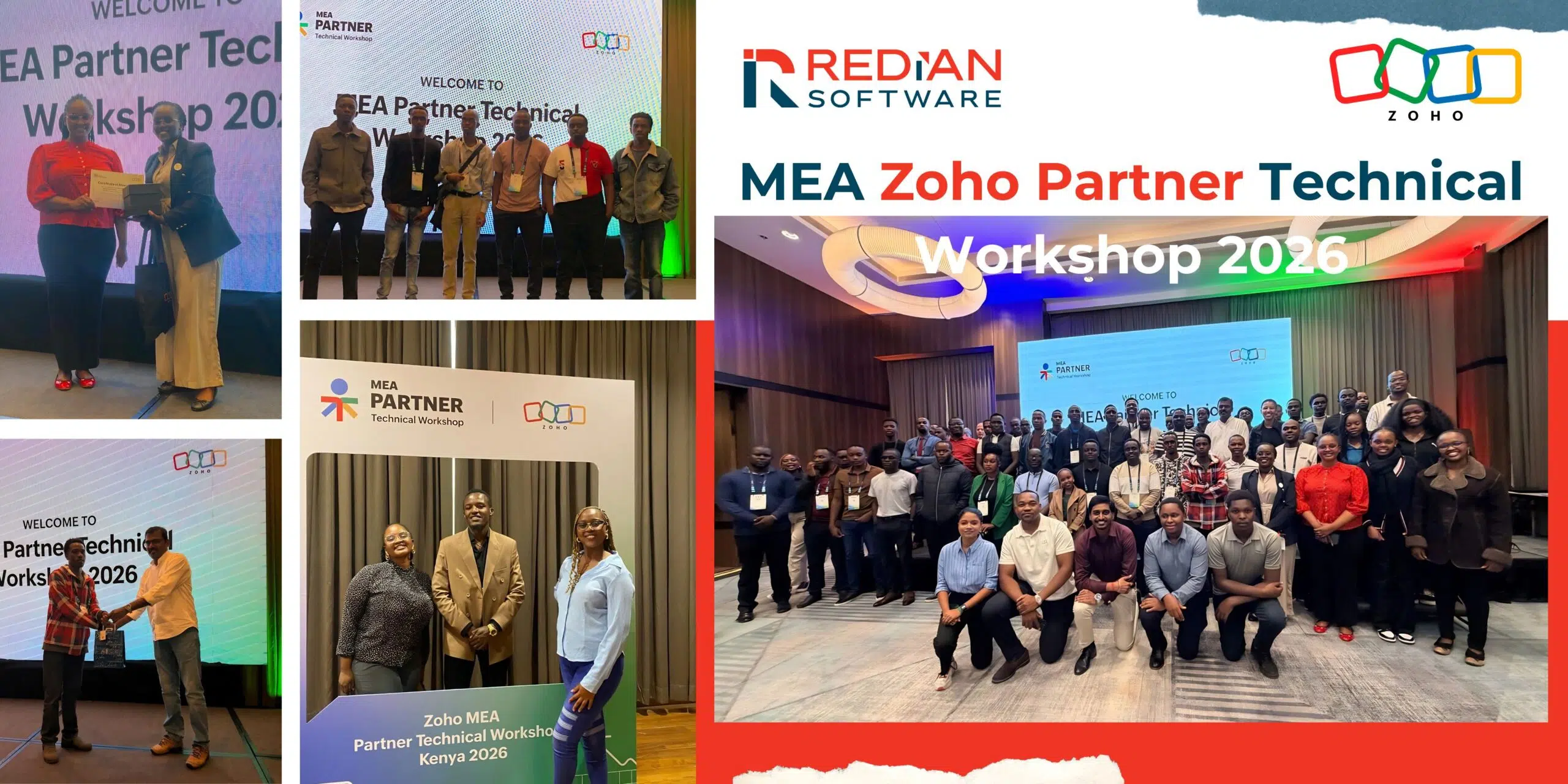
MEA Zoho Partner Technical Workshop 2026: 7 Game-Changing Takeaways
Discover 7 powerful insights from the MEA Zoho Partner Technical Workshop 2026 in Nairobi. Learn how Zia Agents, agentic automation, and Zoho RPA are transforming business operations across Africa. By Redian Software, Advanced Zoho Partner
19 May 2026
Build with Redian
Have a similar build in mind?
We've shipped crm systems for banks, insurers, brokers, MFIs, SACCOs and enterprises across the USA, UK, Africa, UAE and India. Book a 30-min call with a senior engineer — no pitch deck, just a sharp first read on your initiative.
- CMMI Level 3 Appraised · ISO Certified delivery
- 1 business day response · NDA on request
- Senior engineers, not sales — first call