
MEA Zoho Partner Technical Workshop 2026: 7 Game-Changing Takeaways
Discover 7 powerful insights from the MEA Zoho Partner Technical Workshop 2026 in Nairobi. Learn how Zia Agents, agentic automation, and Zoho RPA are transforming business operations across Africa. By Redian Software, Advanced Zoho Partner
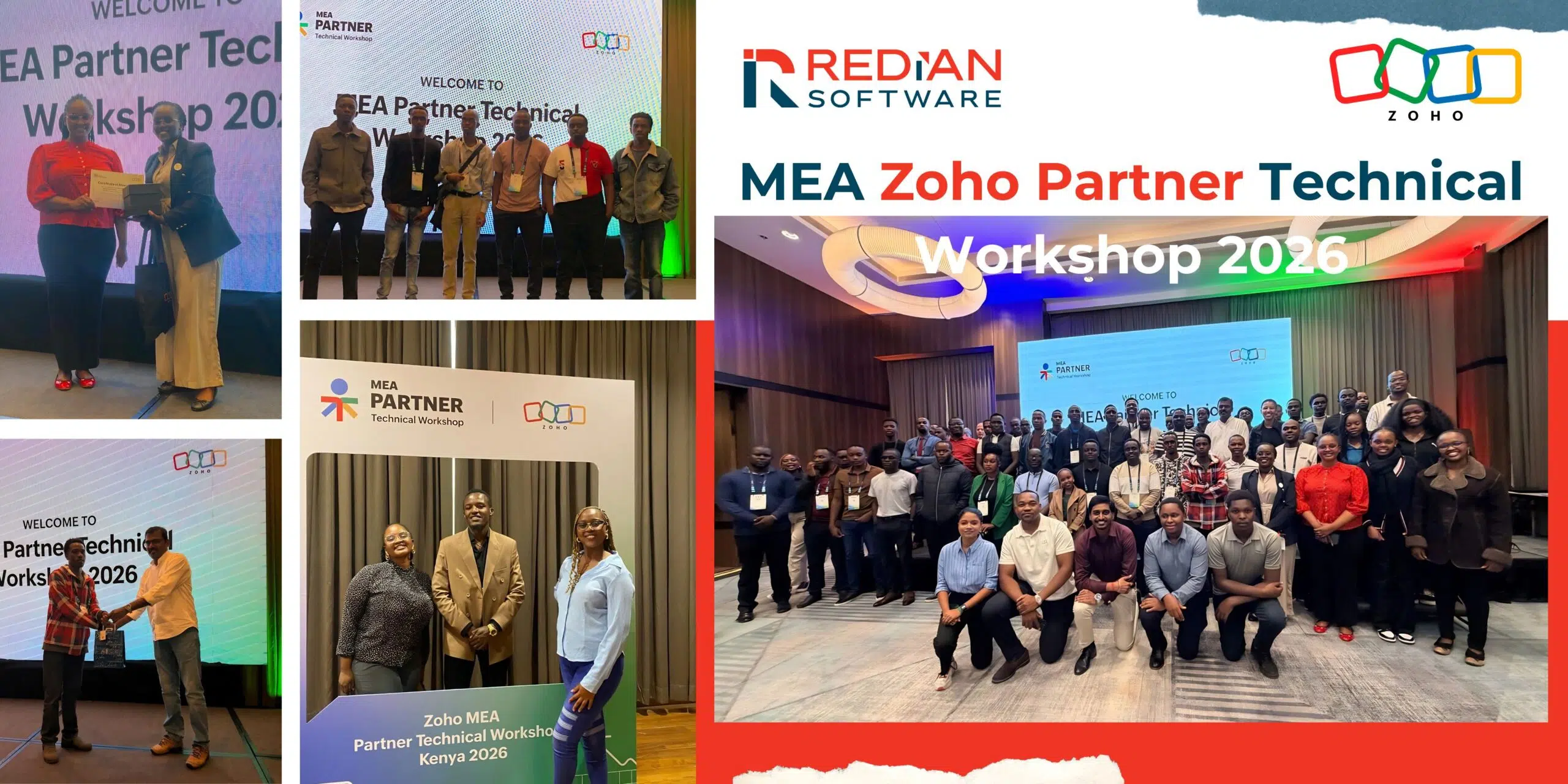
African businesses are drowning in manual process overload, disconnected systems, and AI tooling that promises everything but ships almost nothing usable. The MEA Zoho Partner Technical Workshop 2026, held in Nairobi on 14–15 April 2026, was the first event this year where we saw a credible answer to that problem at scale — and it came in the form of agentic AI that thinks, decides, and acts inside the systems businesses already run on. As an Advanced Zoho Partner and Zoho's Key Business Contributor in Kenya, Redian Software was in the room for every session. Here is what East African business leaders need to know.
Why the MEA workshop matters more than Zoholics or Inspire
Zoho runs many events. Most are public, marketing-led, and aimed at buyers. The MEA Partner Technical Workshop is different — it is a closed-door, partner-only technical enablement programme run for developers, solution architects, and implementation consultants inside Zoho's official partner network across the Middle East and Africa.
The 2026 edition was the third consecutive year Nairobi hosted the workshop. That is not an accident. Kenya is now among Zoho's fastest-growing African markets, with Zoho having established a dedicated head office and training centre in the country. Hosting the regional technical workshop here three years running is a clear signal that East Africa sits at the centre of Zoho's MEA growth story.
For partners, this is the single most important date in the year. It is the only forum on the continent where Zoho's engineering teams walk partners through the roadmap line by line, demonstrate unreleased product behaviour, and answer architecture-level questions with the people who actually wrote the code. The value compounds: insight gained in the workshop flows directly into client implementations the following quarter through our Zoho practice and our broader CRM and ERP implementation work.
The theme: building better, not just building more
Zoho framed the 2026 workshop around a deliberately understated theme — "Building Better with Zoho." After two days inside the sessions, the meaning was clear. Zoho is no longer pitching its 55+ applications as a catalogue of point tools. The pitch now is a single AI-native business operating system, with agentic automation as the connective tissue.
That is a meaningful shift. For years, the conversation around Zoho was breadth: one suite, dozens of apps, one bill. The 2026 conversation is depth and intelligence: the same suite, now wired with autonomous agents that can read context across modules, decide, and execute. The breadth was already a competitive advantage. The intelligence layer is what changes the buying conversation entirely.
How the workshop was structured
Zoho ran the two days as a deliberate progression rather than a feature parade. Day One was about understanding — how the ecosystem fits together architecturally. Day Two was about doing — building working solutions on top of it.
Day one: the ecosystem as one platform
Day One sessions worked through how Zoho's applications connect at the data, workflow, and identity layers. Partners explored product interdependencies, walked through real customer use cases, and built a shared technical language for how modules communicate. The emphasis was on the ecosystem as a unified operating layer, not a federation of separate products. For implementation teams used to stitching tools together with middleware, this reframing matters — it changes what is worth building custom versus what is already available natively.
Day two: building, not watching
Day Two moved partners into hands-on environments. We worked through configuration exercises, agent builds, automation scenarios, and integration patterns drawn from live customer situations. This is the part of the workshop that separates it from generic vendor training — the problems were real, the data was real, and the architects from Zoho's product engineering teams were on the floor answering questions in real time.
Takeaway 1: Zia Agents are no longer a demo, they are a product
Zia Agents were the centrepiece of the workshop and the clearest signal of Zoho's direction. These are not chatbots. They are autonomous units of work with defined roles, permissions, and decision authority that operate inside the Zoho ecosystem on behalf of a human.
A Zia Agent can read a CRM record, pull related invoices from Books, check stock in Inventory, draft a response in Mail, and update Project tasks — without a human clicking through screens. The agent is given a goal and the boundaries within which it can act. It then executes.
For our clients, this collapses entire categories of repetitive work. Sales operations follow-ups, AR collections nudges, lead enrichment, support triage — all of these can now be agent-owned with a human reviewing exceptions rather than driving every step. This is the same architectural pattern we already deploy in our AI/ML consulting and AI/ML development engagements, now available natively inside Zoho.
Takeaway 2: agentic automation changes the implementation playbook
Traditional Zoho implementations were built around workflows, blueprints, and custom functions. Each was a deterministic rule: if X, then Y. Agentic automation introduces a third layer — judgement.
That sounds abstract, so here is the practical consequence. When we scope a project today, we ask which steps need a rule and which need a decision. Rules go to workflows. Decisions go to agents. The split is new, and it changes how we estimate, how we test, and how we hand over. Partners that do not adapt will keep building yesterday's automation and miss the productivity gains their clients are about to demand.
Takeaway 3: Zoho RPA is the bridge to legacy systems
One of the most useful sessions covered Zoho RPA — robotic process automation that operates at the user-interface layer of any application, Zoho or not. This matters because most African enterprises do not run on Zoho alone. They run on a mix of Zoho, legacy core systems, government portals, banking interfaces, and spreadsheets.
Zoho RPA gives us a clean way to automate work that crosses those boundaries without rebuilding the legacy system. Combined with Zia Agents, the pattern is powerful: the agent decides what needs to happen, the RPA bot executes the steps in the legacy application, and the result flows back into the Zoho record. For BFSI clients in particular — banks, insurers, and brokers carrying decades of legacy infrastructure — this is a practical path to automation that does not require a core replacement.
Takeaway 4: the platform is now the integration story
Zoho's integration story used to be Marketplace connectors and Deluge functions. The 2026 platform story is different. Catalyst (Zoho's serverless platform), Zoho Flow, Zoho Creator, and the unified data layer underneath them now form a coherent integration backbone.
For complex programmes — the kind we run for enterprises through custom software development and our offshore development teams — this changes what we recommend. More logic stays inside the Zoho platform; less needs to be lifted into a separate middleware tier. Total cost of ownership drops, and the system stays observable end to end.
Takeaway 5: data and AI governance moved up the agenda
Zoho spent meaningful workshop time on governance — model selection, data residency, prompt boundaries, audit logs, and the controls that determine what an agent is allowed to do and see. This is the right conversation. The thing that stops enterprise AI in regulated industries is not capability; it is the absence of controls boards and regulators can sign off on.
For our African banking and insurance clients, where the Central Bank of Kenya, IRA, and regional regulators all have a view, this matters. Agents are only useful if they are auditable. Zoho's framing — agents as governed actors with logged decisions — fits the regulatory reality on the ground.
Takeaway 6: Kenya is now a Zoho strategic hub
The workshop made clear what was already visible on the ground. Kenya is not a satellite market for Zoho — it is a hub. The Nairobi office, the training centre, the third consecutive year hosting the regional partner workshop, and the depth of the Kenyan partner ecosystem all point the same direction.
For businesses in Nairobi, Mombasa, Kisumu, and across the wider East African Community, this means faster access to product expertise, regional pricing, local enablement, and partners with direct lines to Zoho engineering. It is also why we have invested heavily in our Nairobi delivery hub alongside our other global delivery centres.
Takeaway 7: the partner role is shifting from configuration to architecture
Perhaps the most important takeaway was about the partner economy itself. Five years ago, a Zoho partner mostly configured. Today, a credible partner architects. The work has shifted from clicking through layouts to designing agentic systems, governance models, integration topologies, and AI-augmented business processes.
That is good news for clients. It means the partner conversation has moved up the value chain — closer to business outcomes and further from button-pushing. It is also a higher bar. Not every partner will make the transition. The ones that do will be the ones who understand both Zoho's platform depth and the engineering discipline required to deploy autonomous systems responsibly.
What this changes for our clients in 2026
The capabilities Zoho unveiled in Nairobi will be in our client conversations within weeks. Three things change immediately.
- Implementations now include an agent design phase. Every scoping conversation asks where judgement belongs and where rules belong.
- Legacy-to-Zoho integrations get cheaper. RPA plus agents replaces a class of middleware projects we used to quote separately.
- AI governance becomes part of the delivery deliverable, not an afterthought — particularly for our regulated insurance and banking clients.
The clients who move first will compound the advantage. Agentic automation is one of those shifts where the gap between early and late adopters does not stay small.
Building with Redian
Redian Software has been an Advanced Zoho Partner since 2017, and our Nairobi delivery team works with banks, insurers, brokers, manufacturers, and high-growth businesses across East Africa. If you want to translate what came out of the MEA Workshop 2026 into a concrete plan for your business — Zia Agents, RPA, governance, or a full platform implementation — start a conversation with our team on the contact page. We will give you a straight read on what is real, what is ready, and what is worth doing first.
Stay current with our insights
One monthly email. Banking, insurance, AI/ML and CRM field notes. No spam.
We respect your privacy. Read our Privacy Policy.
Keep reading
More from CRM
CRM
Finding the Right CRM Development Company in India
Why India has become a global hub for CRM development, what to look for in a partner, and how Redian delivers on Salesforce, Zoho, SuiteCRM and SugarCRM.
05 Jun 2026
CRM
Complete Guide to Becoming a Certified Zoho Developer in India — Your Path to Success
Certification levels, salary bands, in-demand skills and a 12-month action plan to build a career as a Zoho Developer in India.
22 May 2026
CRM
Data privacy in CRM — why SuiteCRM is ideal for regulated industries
For banks, insurers and fintechs, data sovereignty isn't optional. Why open-source SuiteCRM remains the right call for regulated CRM workloads.
06 Apr 2026
Build with Redian
Have a similar build in mind?
We've shipped crm systems for banks, insurers, brokers, MFIs, SACCOs and enterprises across the USA, UK, Africa, UAE and India. Book a 30-min call with a senior engineer — no pitch deck, just a sharp first read on your initiative.
- CMMI Level 3 Appraised · ISO Certified delivery
- 1 business day response · NDA on request
- Senior engineers, not sales — first call