
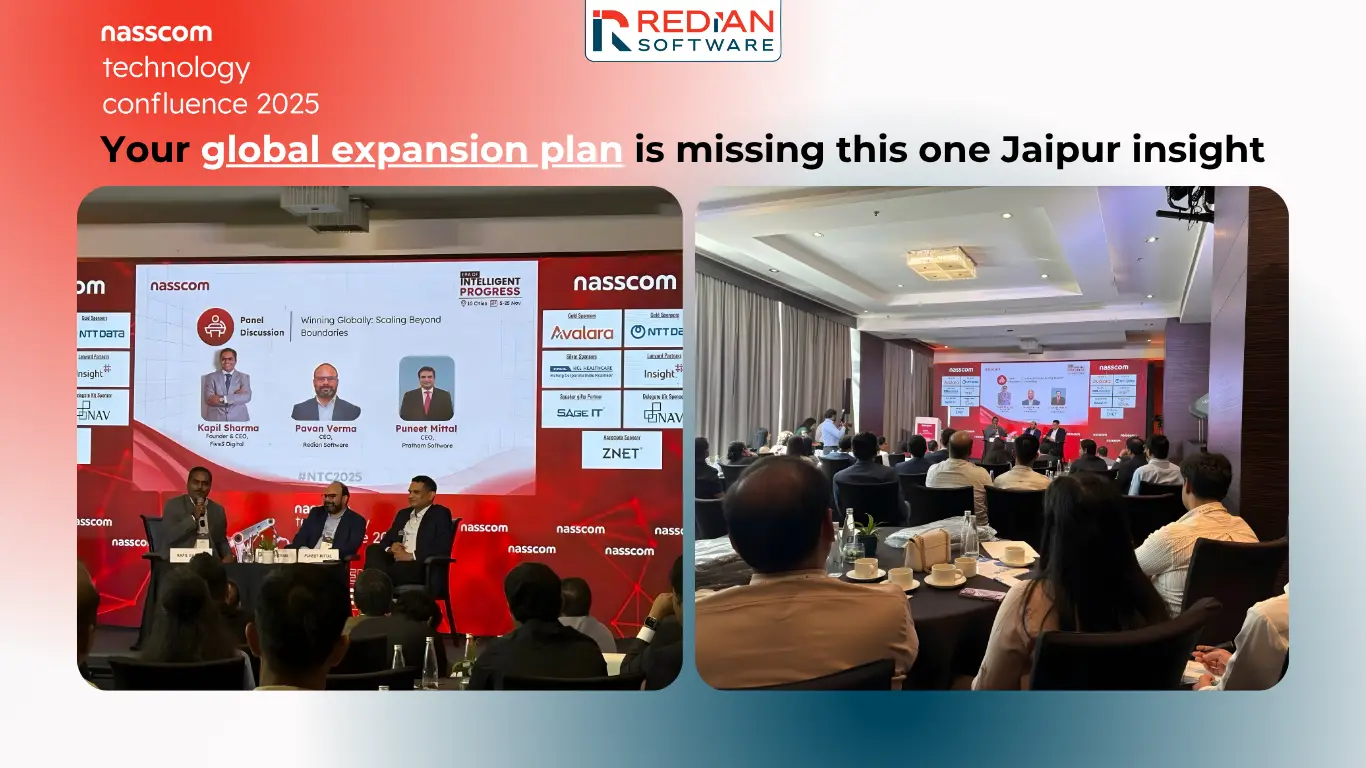
India's tech SMEs are at an inflection point. The companies that scaled past the 200-person mark on the back of a single anchor customer or a single geography are now hitting a ceiling — and the playbook that got them here will not get them to the next stage. That was the underlying tension at the NASSCOM National Technology Confluence (NTC) Jaipur edition, and it is the conversation our CEO Pavan Kumar Verma was invited to lead.
The Jaipur agenda: scaling beyond boundaries
NTC Jaipur convened founders, CXOs and policy voices from across India's tech SME sector under the theme Scaling Beyond Boundaries. The format was deliberately working-session rather than keynote — fewer set-piece talks, more candid panels on what is actually working for Indian software firms expanding into Africa, the Middle East and Southeast Asia.
Pavan participated on the globalisation panel, drawing on Redian's own footprint across five delivery hubs spanning Noida, Nairobi, Dubai, London and New York. The conversation cut across go-to-market motion, delivery operating models, talent strategy and the unit economics of multi-region support. What follows is a distillation of the themes that landed hardest with the room.
The unit economics of going global have changed
For a long time, the conventional wisdom held that an Indian SME needed to cross a certain revenue threshold — usually quoted somewhere between USD 10M and 20M ARR — before international expansion made financial sense. The cost of regional sales heads, local entities, time-zone-overlap delivery teams and compliance overhead simply ate up the upside.
That math has shifted. Three things changed it. First, remote-first delivery is no longer a pandemic improvisation — it is a mature operating model that buyers in Nairobi, Dubai and London now actively prefer. Second, the AI productivity uplift on the delivery side has compressed the cost base, particularly for code-heavy engagements. Third, the buyer landscape itself has matured: mid-market enterprises in East Africa or the GCC are increasingly comfortable contracting directly with an Indian software partner rather than going through a local reseller.
The practical implication is that Indian SMEs can now profitably support customers across five or more regions far earlier in their growth curve than was previously possible. We see this directly in our own staff augmentation and remote engineering engagements, where the friction of running a distributed delivery model has dropped year on year.
Africa is no longer a maybe
The most striking shift in the room was the seriousness with which Africa is now being discussed. For a decade, "we should look at Africa" has been a future-tense ambition for most Indian tech firms. That has changed.
East and West African markets — Kenya, Tanzania, Uganda, Rwanda, Nigeria, Ghana, Cameroon — are generating real, repeatable revenue for Indian SMEs. The patterns are clearest in three areas: CRM and ERP implementation, BFSI core systems, and AI/ML solutions layered onto modernising banking and insurance stacks.
What is actually working
Our own portfolio reflects the trend. The core banking transformation we delivered for a Cameroon-based bank and the InsureMe Kenya aggregator build are both live, multi-year programmes generating ongoing revenue. They are not pilots. They are not proofs of concept. They are production systems serving regulated customers.
What makes Africa work for Indian SMEs, when it works, is a combination of three things: a local delivery presence that the regulator and the customer can see (in our case, our Nairobi hub), domain depth in the vertical being sold into (core banking, policy administration, claims), and pricing that maps to local economics without compromising delivery quality.
Customer concentration is the silent killer
The panel spent considerable time on a risk most growing Indian SMEs underweight: concentration. Fast growth tends to come from one or two whale customers or one dominant vertical. Founders celebrate the growth and underestimate the fragility.
The pattern is well-documented. A firm crosses USD 5M ARR, 60% of which is from a single customer or a single product line. The customer renews, the firm hires aggressively against that revenue, and then the customer churns or renegotiates — and the firm spends the next 18 months in painful contraction.
Diversification has to be a strategic priority, not an afterthought. In practice that means three things:
- A board-level metric for customer concentration, with a hard ceiling (most well-run SMEs target no customer above 15–20% of revenue).
- Deliberate vertical and geographic diversification baked into the annual plan, not opportunistic.
- Productisation or IP creation that decouples revenue growth from headcount growth — so a renegotiation does not immediately translate into a cost crisis.
This is part of why Redian has invested in cross-sector depth — BFSI, insurance, CRM platforms across Zoho, Odoo, Salesforce and SuiteCRM — and across multiple geographies. The diversification is not accidental.
Talent is the binding constraint, not demand
The most counter-intuitive thread of the panel was that most Indian SMEs in the room described themselves as talent-constrained, not demand-constrained. The pipeline of opportunity is fuller than it has ever been. What is missing is the senior engineering and domain talent to deliver against it without compromising quality.
That reframes talent strategy from an operational HR function into a board-level strategic priority. It also explains why the Global Capability Centre model has gained so much traction with international buyers — they are not just looking for cost arbitrage, they are looking for retained, dedicated, India-based engineering capacity that behaves like an in-house team.
What talent strategy looks like now
Building a real talent pipeline today means investing in a few things that used to be optional. Strong employer brand in tier-2 cities. Clear technical career ladders that retain senior engineers past the seven-year mark. Structured upskilling against specific architectural disciplines — AI/ML, cloud-native, regulated-industry compliance. And a recruiting function that operates with the same discipline as the sales function: pipeline, conversion, forecast.
The firms in the room that are scaling cleanly are the ones treating talent as a strategic capability. The ones struggling are the ones still treating it as a recruitment problem.
Redian's NASSCOM involvement
Pavan is a member of the NASSCOM SME National Council, contributing to industry policy and sector advocacy on behalf of mid-sized Indian software firms. The council's remit covers everything from export competitiveness and regulatory engagement to skilling priorities and the SME-specific policy interface with government.
Recent NASSCOM forums where Redian has contributed include the NASSCOM SME Conclave in Hyderabad, the NTC Jaipur edition covered here, and sideline roundtables at the AI Impact Summit in New Delhi. The throughline across all of them is the same conversation: how India's tech SME sector moves from being a talent-export story to being a global-product and global-delivery story.
Build with Redian
If you are scaling an Indian tech SME into Africa, the GCC or Southeast Asia — or you are an international buyer looking for a delivery partner with real presence across five hubs and a track record in regulated industries — we should talk. Get in touch and we will start with your actual constraints, not a generic pitch.
Stay current with our insights
One monthly email. Banking, insurance, AI/ML and CRM field notes. No spam.
We respect your privacy. Read our Privacy Policy.
Keep reading
More from News & Events
News & Events
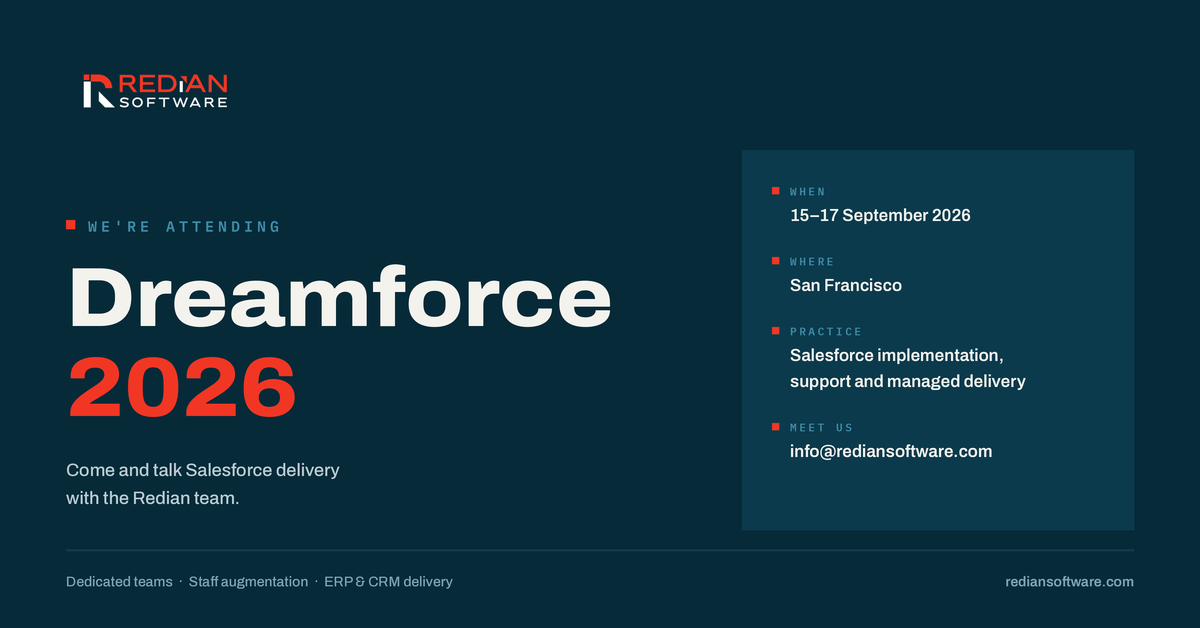
Meet Redian at Dreamforce 2026 — San Francisco, 15–17 September
Redian's Salesforce practice will be at Dreamforce 2026 in San Francisco. Come talk implementation, managed delivery, and what an org actually needs before agentic features earn their keep.
09 Aug 2026
News & Events
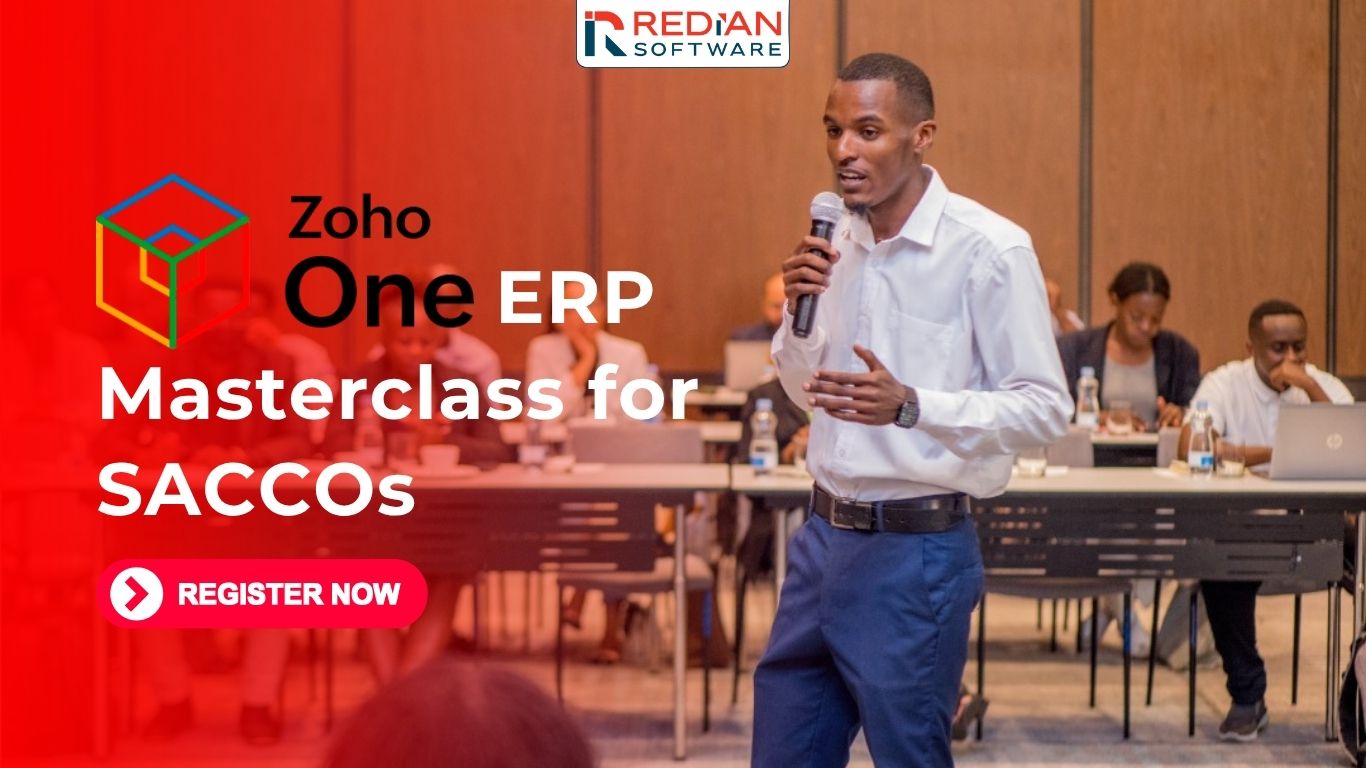
Zoho One ERP Masterclass for SACCOs — Nairobi, 10 July 2026
Free in-person Zoho One ERP Masterclass for Kenyan SACCOs at Hyatt Place Nairobi — live demos of loan automation, M-Pesa Daraja, KYC and SASRA reporting on a unified platform.
24 Jun 2026
News & Events
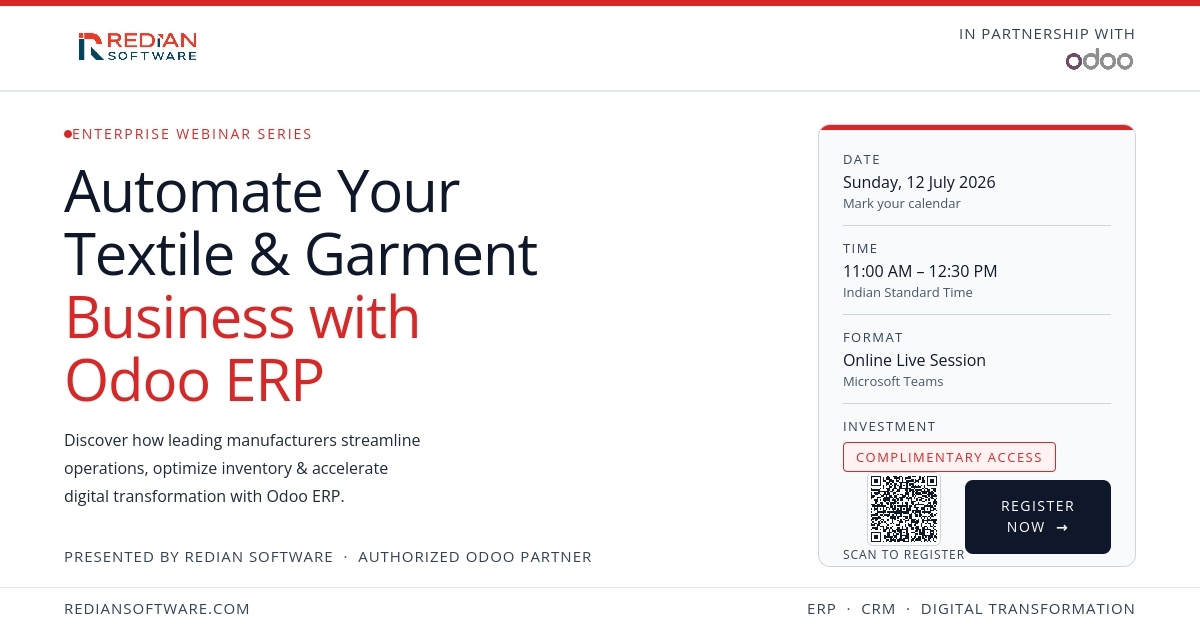
Webinar: Automate Your Textile & Garment Business with Odoo ERP
Free Redian Software webinar on Sun 12 July 2026 — discover how textile and garment manufacturers run inventory, MRP, sales and accounting on Odoo ERP. Online, 90 minutes, complimentary access.
23 Jun 2026
Build with Redian
Have a similar build in mind?
We've shipped news & events systems for banks, insurers, brokers, MFIs, SACCOs and enterprises across the USA, UK, Africa, UAE and India. Book a 30-min call with a senior engineer — no pitch deck, just a sharp first read on your initiative.
- CMMI Level 3 Appraised · ISO Certified delivery
- 1 business day response · NDA on request
- Senior engineers, not sales — first call