
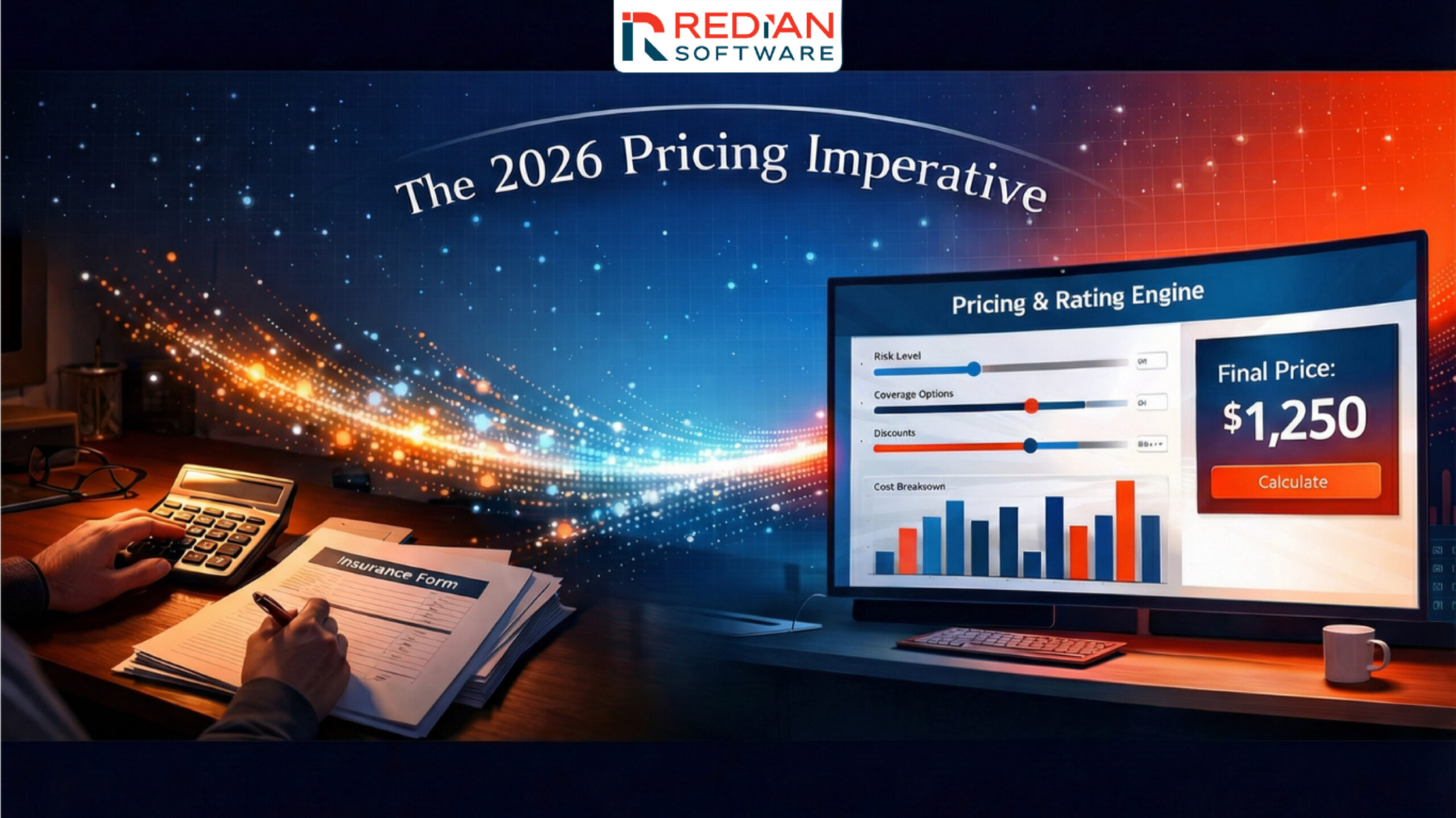
The problem with your 2010 pricing engine
Your combined ratio is bleeding two to three points a year and you can't see where. Legacy rate tables miss interaction effects, can't be A/B tested in production, and need six to eight weeks of actuarial and IT work to absorb a regulatory tweak or a competitor's pricing move. By the time your new rates go live, the market has already moved, and the segments you priced aggressively six months ago are now the ones your competitors are cherry-picking.
Modern ML-augmented pricing engines change the economics. They update daily, capture non-linear interactions across hundreds of variables, run sub-100ms at quote time, and ship with regulator-grade explainability built in — not bolted on. This guide lays out the architecture that works in 2026, the deployment patterns we've shipped under IRDAI, FCA and CBK, and the ROI math you can defend to your board.
What "modern pricing engine" actually means
A 2026-grade pricing engine is not a single model. It is a layered system where each layer earns its keep on a different axis — defensibility, accuracy, latency, or explainability. The architecture we deploy at Redian has five core layers, and skipping any of them tends to surface as a regulator question or a P&L surprise within twelve months.
GLM base layer
The Generalised Linear Model remains the regulator-defensible, actuarially-explainable foundation. It carries the rate filing. It is the model your appointed actuary signs off on, and it is the one you can show a regulator on a Tuesday afternoon without a three-week prep cycle. We never replace the GLM — we extend it.
Gradient-boosted residual model
A gradient-boosted layer learns the residuals the GLM cannot capture: non-linear interactions between driver age, vehicle category and postcode density, or between sum insured, building age and claims history. This is where the accuracy lift comes from. Trained correctly and constrained against protected attributes, it adds two to four combined-ratio points without introducing bias the regulator will reject.
Real-time scoring tier
Sub-100ms inference at quote time, served behind a typed API. Aggregators, broker portals and direct-to-consumer journeys will not wait. Latency above 250ms collapses conversion, and any pricing engine that cannot beat that ceiling under load is, in practice, a batch system pretending to be real-time.
A/B testing and rate version control
Production rate version control with stratified customer assignment. You ship a new rate version to 10% of new business, watch loss ratio and conversion daily, and roll forward or roll back in hours rather than quarters. This is the single capability that compounds the fastest — the insurers who get it right pull two to three points of margin away from the field within eighteen months.
Explainability and drift monitoring
SHAP and LIME reason codes per quote, automated drift alerts when input distributions or output rates move outside expected bands, and an immutable audit trail of every score served. This is the layer that lets you sleep through a regulator visit.
What the numbers look like
Across the pricing engine deployments we've shipped — life, motor, health and SME commercial lines — the pattern is consistent. The exact magnitude varies by line of business and starting point, but the direction does not.
- +2.8 combined-ratio points improvement against legacy rate tables, blended across portfolios
- 40% faster quote speed — modern engines beat legacy on raw latency, not just sophistication
- 94% confidence intervals on auto-bind decisions for low-risk segments, removing underwriter touch from clean business
- 15–25% increase in win rate on quoted business at unchanged loss ratio
The combined-ratio number is the one boards care about, but the auto-bind number is the one that funds the project. A motor book of 200,000 policies where 40% of clean risks bind without underwriter intervention pays back a pricing modernisation programme inside three quarters on operational savings alone — before any pricing lift lands.
Deploying in regulated markets
The promise of ML pricing collapses on contact with regulation if you have not designed for it from day one. Under IRDAI in India, FCA in the UK, CBK and IRA in East Africa, and the patchwork of state filings in the US, four obligations come up in every conversation: bias testing across protected attributes, per-decision explainability, immutable audit trails, and prior filing of methodology.
We've shipped pricing engines under all four regimes. The pattern that works is a clean separation between the rate-filed methodology — which is the GLM plus a bounded, documented adjustment from the residual model — and the broader scoring infrastructure that supports underwriting decisions, fraud signals and customer segmentation. The filed methodology is what the regulator reviews. The wider stack is what the business runs on. Both sit on the same ML pricing and rating engine platform but serve different audiences with different SLAs.
Bias testing
Disparate impact testing across age, gender, postcode-as-proxy-for-ethnicity, and any other attribute the local regulator names. We run this at every model refresh and gate deployment on it.
Explainability
Per-quote reason codes that a customer service agent can read out, and a customer complaints officer can defend in writing. Reason codes are generated at score time, stored against the quote ID, and surfaced through the same API the quote engine uses.
Audit trail
Every score, every input, every model version, every rate version — written once, immutable, queryable for seven years. This is non-negotiable and it is the single most common failure mode we see when we are called in to clean up someone else's deployment.
The integration surface that matters
A pricing engine that cannot talk to your policy administration system, your claims data warehouse and your broker portal is a science project. The integration surface is where most programmes lose six months.
The connections that have to work from day one are the policy administration system for new business and renewals, the claims system for loss data feedback into the model retraining loop, the insurance broker management system where intermediated business actually originates, and the claims management platform for severity signals. We treat these as typed contracts with schema versioning and contract tests, not as ad-hoc REST endpoints documented in a Confluence page that nobody updates.
For carriers with active reinsurance arrangements, we also wire pricing signals into the reinsurance placement system so that treaty cessions reflect the actual risk profile the new pricing engine is selecting into.
The ROI math you can take to the board
The business case rests on four lines, and each is defensible from your own data before you sign a contract.
First, loss ratio improvement from better risk selection. On a portfolio with a 65% loss ratio, a 2.8-point combined-ratio improvement on the pricing-controllable share is roughly 1.5 to 2 points of loss ratio — between 1.5% and 2% of gross written premium dropping straight to underwriting profit.
Second, conversion lift on quoted business. A 15% win-rate increase on quoted but unbound business, at unchanged loss ratio, is pure top-line growth on existing acquisition spend.
Third, operational cost-out from auto-bind. Underwriter capacity freed from clean business gets redirected to genuinely complex risk, where the marginal hour is worth ten times what it is on a vanilla motor quote.
Fourth, regulatory and audit cost reduction. Filing cycles drop from quarters to weeks. Audit prep drops from a six-person scramble to an automated report.
Across the four lines, payback on a mid-sized programme — a national motor or SME commercial book — typically lands inside twelve months, with the bulk of the upside in years two and three as the rate-version-control loop compounds.
Where most programmes go wrong
Three failure modes show up repeatedly. The first is treating the GLM as legacy and trying to replace it outright with a tree-based model; the regulator conversation kills the project. The second is shipping without drift monitoring, then watching loss ratio quietly deteriorate for nine months before anyone notices the input distribution has shifted. The third is underinvesting in the integration layer, so the engine technically works but cannot be wired into the quote journey, and a six-month build sits on the shelf.
All three are avoidable with the right delivery pattern: actuarial, data science and engineering working in one team, not three, against a roadmap that ships a usable system in 90 days and iterates from there. That is the pattern our AI/ML consulting and insurance practice deliver together, and it is the one we recommend regardless of who you choose to build with.
Build with Redian
Redian has shipped pricing and rating engines for insurers across India, the UK, Kenya, Uganda and the UAE — life, motor, health and SME commercial. We bring actuarial credibility, ML engineering depth and regulator-grade delivery discipline in one team, working under IRDAI, FCA, CBK and IRA. If you are sizing a 2026 pricing modernisation programme, start with our ML pricing and rating engine practice and the insurance case studies behind it.
Stay current with our insights
One monthly email. Banking, insurance, AI/ML and CRM field notes. No spam.
We respect your privacy. Read our Privacy Policy.
Keep reading
More from Insurance
Insurance
Insurance broker management — from policy to profit in 2026
A practical guide to what a modern broker management system has to do — and how to evaluate one.
22 May 2026
Insurance
Beyond Manual Models — Real-Time, Data-Driven Insurance Pricing with Machine Learning
Traditional insurance pricing is static and reactive. Here's how machine-learning pricing engines ingest telematics, wearables and IoT data to deliver real-time, personalised premiums.
08 May 2026

Insurance
Insurance broker management system — full policy-to-profit guide
The complete guide to insurance broker management systems in 2026: features, deployment, costs and how brokerages recover $187K+ annually through proper automation.
26 Mar 2026
Build with Redian
Have a similar build in mind?
We've shipped insurance systems for banks, insurers, brokers, MFIs, SACCOs and enterprises across the USA, UK, Africa, UAE and India. Book a 30-min call with a senior engineer — no pitch deck, just a sharp first read on your initiative.
- CMMI Level 3 Appraised · ISO Certified delivery
- 1 business day response · NDA on request
- Senior engineers, not sales — first call